
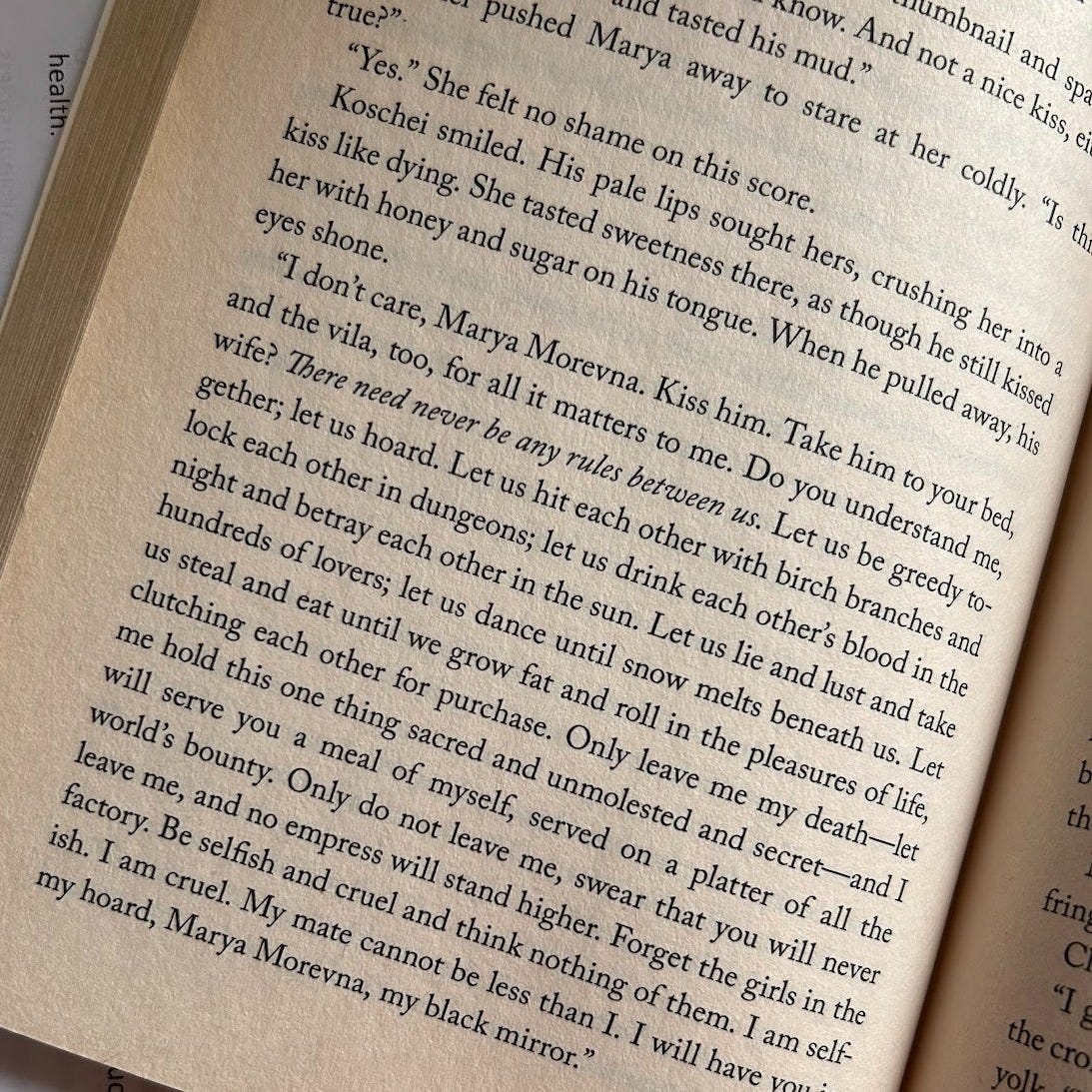
Thanks for reading my newsletter! All opinions expressed here are strictly my own. Find me on TikTok, Instagram and Bluesky. Ultracold publishes every Monday and you can now pre-order my debut book, Entangled States: A Life According to Quantum Physics.
Please note that this letter contains adult content and some strong language.
For the first several years of this newsletter, I tasked myself with writing something about love in February and I kept up with it until last year when my default essay format morphed into a collection of somewhat steamy, still very nerdy, semi-autobiographical vignettes. Consider the following a sequel, possibly a part of a yearly series.
REFRACTION
When the yoga teacher declares that the theme of the class is “hips and hearts,” you know that the universe is smiling upon you. Later, when you’re told to turn over onto your stomach but keep your hips high, the thought will feel bigger and warmer, but right now, on the mat, you try to let it mingle with all the other thoughts that you ought to allow to pass by. Yoga teachers love to say that you shouldn’t evaluate any passing thoughts. Instead, you are always told, you should observe them as they come and go, like watching clouds without interpreting their shapes. Why have you never thought to ask where exactly those thoughts are going? But that’s just another lingering thought. Being lucky and being unknowledgeable are both value neutral propositions here. Of course, later, when your hips hold sturdy but you sink into the bed a lot more than you ever sink into the mat, you will be perfectly capable of keeping your mind blank. There is, after all, very little that is as meditative as being steadily fucked.
The climax of the class is folding into pigeon pose and though you feel warm and morning light enters the studio in an encouraging shade of gold, you anticipate struggle. Forget keeping your shin parallel to the mat, you’ve never been flexible enough for that. With a block under your hip and a careful look at whether your back leg has splayed too much, you do eventually fold, careful to not collapse in the shoulder, to not make your heart space any smaller than it has to be. You need to keep it open, to encourage your heart to be hungry. When you put your head down, forehead touching hands, the golden light warmly dances on your neck. It’s not that you are in pain as much as everything within you is tugging on everything else, a tension that feels both like it will stay forever steady and like it might snap you into pieces at any moment. You like pain, you know that about yourself, but this is about discipline, not the kind where someone tells you what to do, which you also like, but the kind that you must impose on yourself. You imagine a ball of something bright and white and searing right where the tension is the most concentrated and breathe until it diffuses throughout you. It feels vulnerable to be so bright.
It’s not that all of our feelings live in our hips, just the old ones, your lover will later say, their bedroom alternatingly awash in soft pinks, oranges and purples. People carry anger in their shoulders, but it’s mostly shame that settles into the hips, they’ll assert and you’ll think about crying in pigeon in hot yoga during one of the darkest years of your life. When they bend you over, when they hit the side of your ass and bite the part of your hip where the bone is closest to skin, you will not have the presence of mind to consider what exactly has changed since. But a lot of sweat, salt and aching flesh later, you will feel for whatever may be collecting in your hips right now. Instead of shame, instead of that searingly bright thing, you will only find softness, the sort that can only be achieved through the generosity of another body’s heat.
(“The effectiveness of the symbology and experience of pain is based in the way it bridges basic, primal sensations with our highest qualities as human beings existing in a community with other humans.”)1
Eventually, you will start noticing the light shift colors again and you will feel held by each of them.
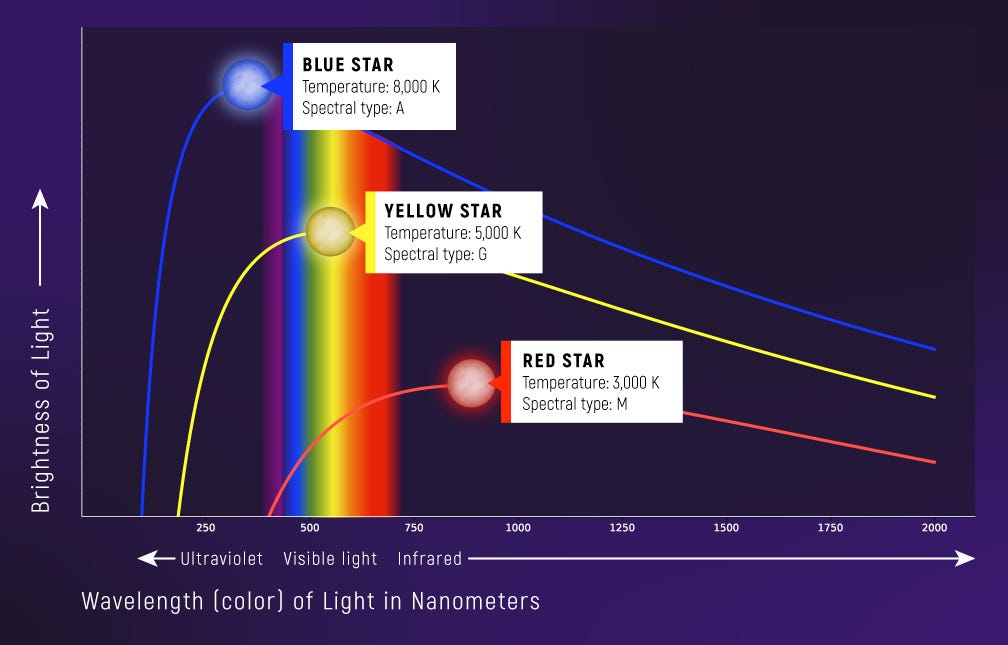
In the visible light spectrum, often depicted as a rainbow straightened out into a single rectangular strip, violet and blue are neighbors while orange is further away, closer to red. Pink doesn’t live here at all because there is no light wave that purely carries this color. Accordingly, there are no pink stars, but if you spot a star that is orange or blue, you can immediately tell how hot it burns. Light orange means something like 4900F, and light blue burns hotter, closer to 13,000F. Our Sun, which mostly shines white, sits somewhere in-between these two temperatures. In several billions of years it will turn more red, but at that time it will also become much bigger and heat the Earth so much that most of our planet will become molten.
At the bottom of the notion that you can determine a star’s temperature by studying its colour is the phenomenon of “black-body radiation.” A “black-body,” is the most well-behaved object in physics, a thermodynamic body ideal. It absorbs any bit of electromagnetic radiation that approaches it, regardless of its incidence angle and wavelength. No matter how the particles of light hit it, no matter if they’re the long-wavelength chunks of the infrared or the fast-oscillating bits of ultraviolet, the black-body takes it.
When it is in thermal equilibrium the black-body gets hot and re-emits some radiation. It does so in a neat way, creating a spectrum so predictable that you can divine how hot it got by the colours it shines the most. Stars like our Sun are not perfect black-bodies, but many objects that radiate can be approximated as one. In 1704, Isaac Newton wrote that “black-Bodies conceive heat more easily from Light than those of other Colours do, by reason that the Light falling on them is not reflected outwards, but enters into the Bodies, and is often reflected and refracted within them.”
In textbooks, the black-body is typically depicted as a cavity, or an enclosure, pierced by one thin hole. Radiation that enters such a cavity is very unlikely to escape because its interior is that much larger than the hole. Illustrations usually show rays of light bouncing inside from one inner wall of the cavity to the next, bending and reflecting each time, but always staying trapped inside. The cavity just takes all the light it can get and keeps it within itself. It’s sort of obscene.
It’s sort of aspirational.
The couch is a sight of struggle in the sense that you are struggling to stay on it, but also in the sense that you are struggling to be patient, which means that you are struggling to be ideal and good. Now your hips may actually be too warm and open, because they keep sliding lower, which puts your knee precariously close to the edge of the couch. You are too eager, and the eagerness fills your body. You are told “not yet,” and then “not yet,” once more, but the way desire is bouncing within you makes it difficult to stay bent at just the right angle, in perfect alignment with the desires of your lover. The TV glows cold and blue, but you’re keeping your eyes shut tightly anyway. A sharp hunger grows in your core, like you swallowed the Sun and it is now expanding, threatening to make you molten. Of course, it is delicious to be in such a struggle.
The next morning, when your lover says “I had a great time last night,” and playfully pats your ass, you will be struck by how many times you’ve encountered each other in this place where discipline and hunger coexist, where it is safe to whimper and beg, and yet it has stayed so incandescent and sharp. Their hand is still heavy when they hit you, their voice still stern, you still want to take in as much of them as any body can.
On the couch, you resign yourself to asking for a change of location. The ask feels more humiliating than being spanked or begging to be fucked, but your left knee and your left hip are feeling precarious. Whichever rational part of your mind still resides behind your eyes knows that you’re more likely to get injured by falling off the couch than at the hands of your top. You move to the bedroom where the light is right overhead and brutally bright. You bury your face into pillows, forehead sinking into purple and blue fabric between your outstretched arms. Did you buy those pillows back when you were both in school? The thought passes by too quickly for you to form a definitive answer.
Back then, you fucked late into the morning on weekends then wandered the small town baffled that brunch time had already concluded. You were less free back then even though the amount of space that needed to be filled within you was already cavernous. The connection you were forging had not yet become strong enough to allow yourself to break open within it. Surrender wasn’t really on the table, if anything, you’d climb on top and flirt with taking control. Now, you wish to be porous, you wish for the bright white light to meet the heat within you and melt you away. “You are taking this so well,” a voice from above affirms you before another smack propagates through your side. You are eager to be used all the way up to oblivion.
(“Embracing the refuse of the subconscious and not fleeing from pain, conflict, despair and other ‘negative’ experiences, has the potential to enrich our souls.”)2
By the time you can come, you’re on your back, the bright light directly above you. As your breath catches in your throat and your eyes narrow, its glow recedes from view but you can’t help feeling that you are actually so much alike. “Please,” you whisper, “please.”
(The process of verbal formation and ensuing enacting of sexual scripts is also a means for accessing ‘subspace’ (an altered state of consciousness experienced by submissives), by “encouraging a heightened awareness of the self that could in turn further an expansion and evolution of an individual’s identity.”)3
The world dissolves and so do you.
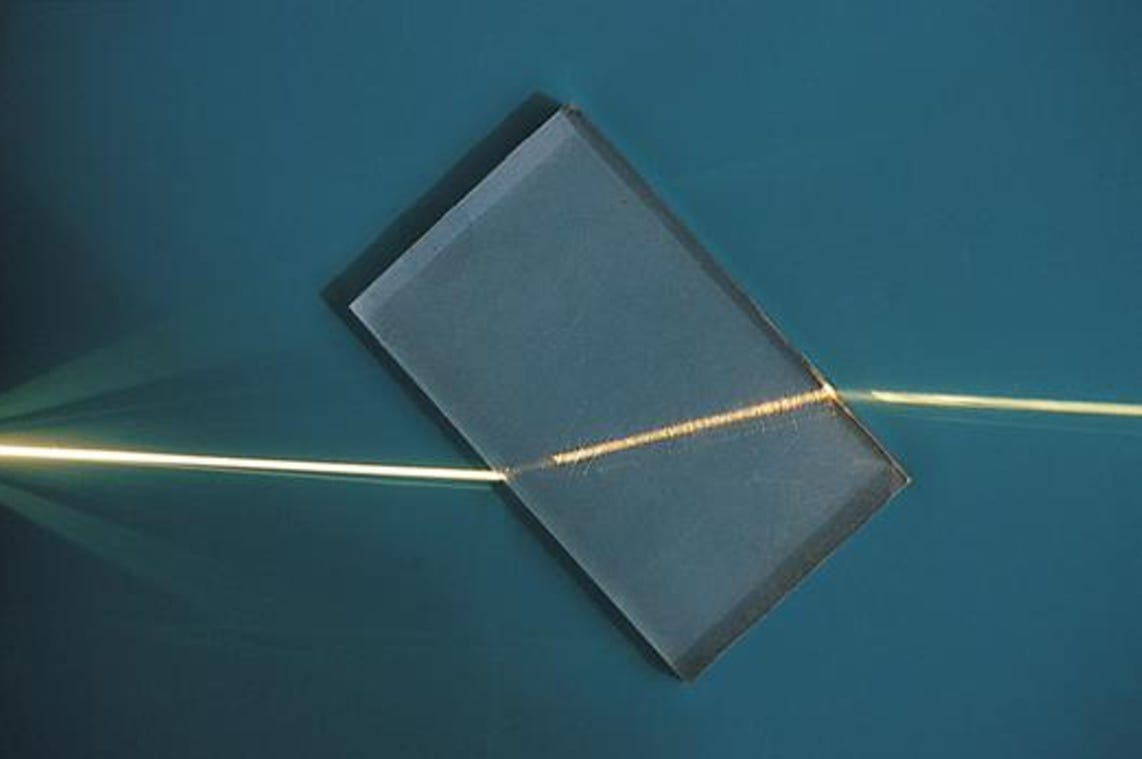
In 1621, Willebrord Snellius, a Dutch astronomer, wrote down an equation for how light bends, or refracts, as it travels from one medium to another, such as crossing from air into water. This bending is why when you look at fish in an aquarium, their apparent position is not equivalent to their exact position because the light bent while carrying visual information about them towards your eye. Snellius’s equation is now taught as “Snell’s law,” except in some French texts that attribute it to the philosopher and mathematician Rene Descartes. While Descartes independently discovered this law for light’s bending in the 1630s, its true provenance dates much earlier, to the work of the Islamic scholar and mathematician Abu Said al-Ala Ibn Sahl and his 984 On the Burning Instruments. He derived the law after reading a treatise on optics by the ancient Greek thinker Ptolemy. Ptolemy had gotten the equation wrong and Ibn Sahl fixed it, but history didn’t pay much attention.
If light didn’t refract when it moved from air to glass, corrective lenses would not correct, magnifying glasses would not magnify, and you could never use a cleverly shaped piece of glass to set something on fire. Lenses focus light by bending it, by pushing its rays closer to each other until they touch. The point at which they touch, the light’s focus, is what astronomer Johannes Kepler called the “fireplace,” or “burning point.”
And burning is a mainstay of the history of studying light; a long succession of famous thinkers put their energy into trying to understand “burning glasses,” or convex mirrors and lenses that could be used to cajole the Sun into igniting something. The oldest reference to the use of lenses, in the 5th century BCE, actually references burning glasses. Vestal Virgins also used burning mirrors to reignite their temple’s sacred fire. “New fire is to be gained by drawing a pure and unpolluted flame from the sunbeams,” wrote Plutarch before describing how such fire is to be obtained by using “concave vessels of brass,” that cause light rays to converge, acquire the force of fire and rarefy the air enough to burn anything in its path, to consume it with greed.
So, with some will and know-how, you can set up a whole process, a scene, if you’d like. You need to bend, to focus, to ignite, to burn, to become consumed, in that order, with diligence and discipline.
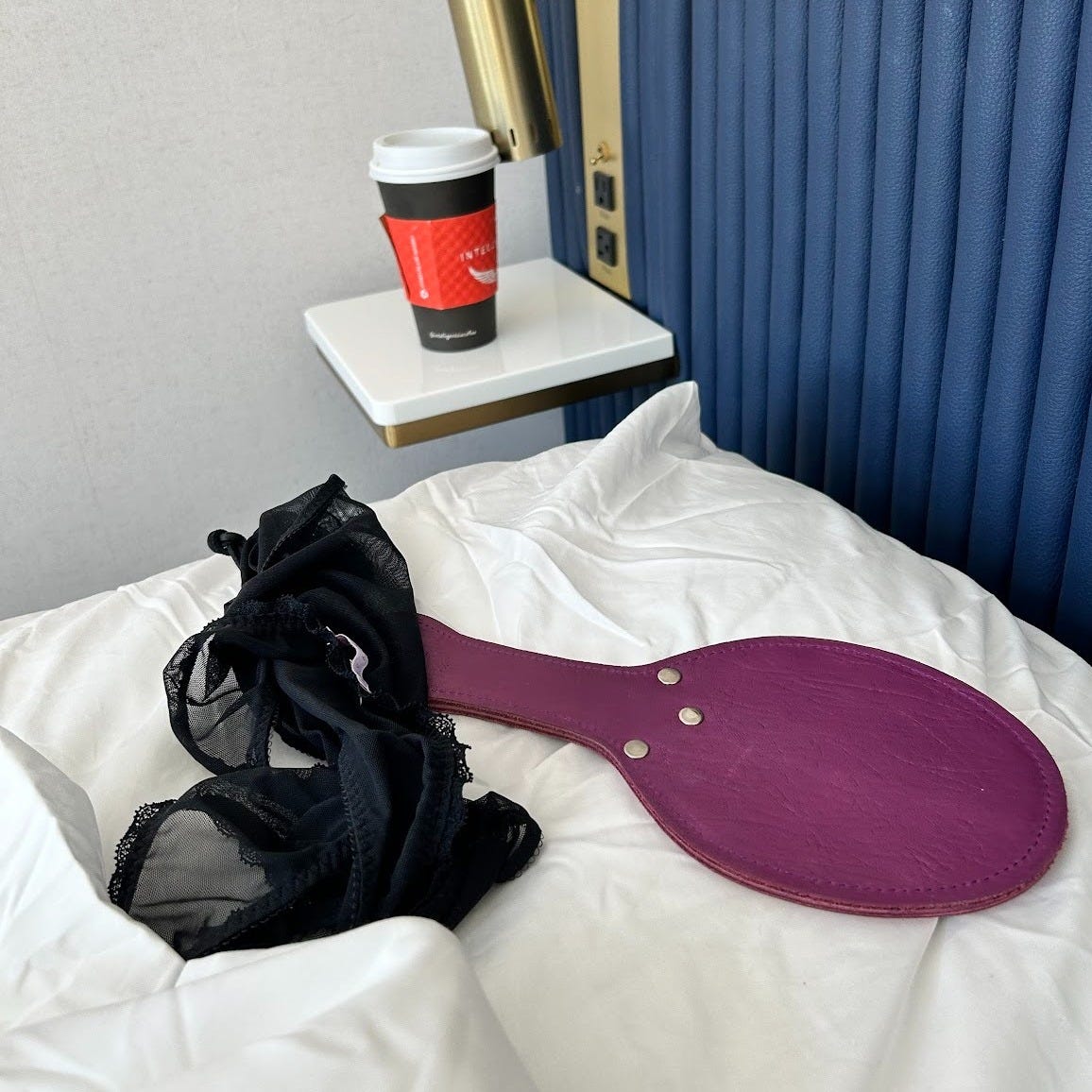
The thing about being consumed is that you are simultaneously the most important person in the room and barely a person at all. You are there to absorb the rays of desire, the flux of wanting, to open your heart, your hips, your mouth, your whole being to a kind of brightness and heat that you know will overpower you, that will burn you. Whatever wordless maelstrom of impulse, instinct and hunger a lover may project onto you, you ought to contort to amplify, convex and concave alike. This becomes your act of service, to be the boundary between reality and madness where another’s desire can refract; where as you bend, it can focus. When you are there, bent over, on your knees, your face against the pillow barely feeling like a face at all, your flesh offers to house a “fireplace” somewhere between your heart and your hips. You breathe heavy and ragged instead of crackling like a fire. You sweat mostly because you cannot actually melt, though, if you’re lucky, your thoughts will liquify before it is all over.
(“The body and ego are inextricably intertwined and therefore to hurt the body is to challenge the ego.”)4
Later, as you feel yourself reconstituting into the same hardened body that has served you well in school, at work, and everywhere else where being in control is a necessity rather than a choice, you will begrudgingly note an inkling of soreness in your hip. I guess you will have to try this all over again.
Best,
Karmela
Charles D’Avalon, Alicia. 2020. Pain and Power: BDSM as Spiritual Expression. Inquiries Journal 12, http://www.inquiriesjournal.com/a?id=1844
Alison Moore, “Spiritual Sadomasochism,” in Masochism: Disciplines of Desire (Sydney: PG ARC Publications 1998)
Charles D’Avalon, Alicia. 2020. Pain and Power: BDSM as Spiritual Expression. Inquiries Journal 12, http://www.inquiriesjournal.com/a?id=1844
Ibid.
I'm speechless, this was incredible!
Physics bending yoga over the couch.