
Thanks for reading my newsletter! All opinions expressed here are strictly my own. Find me on TikTok, Instagram and Bluesky. Ultracold publishes every Monday and you can now pre-order my debut book, Entangled States: A Life According to Quantum Physics.
ACCEPTANCE
In my memory of Leslie Jamison’s The Empathy Exams, a book from twelve years ago that I found deeply impactful at a time when the personal essay industrial complex was in full swing and I was ardently harboring hopes of becoming an important academic, it includes a piece in defense of being overly earnest and emotionally extra. I was the perfect audience for this, both because I was consuming lots of first-person writing online, which often overflowed with pathos but lacked editing, and because I felt self-conscious about just how badly I wanted to be a proper scientist and intellectual. Revisiting the essay in question, titled “In Defense of Saccharin(e),” it’s less about earnestness and a lot more about sentimentality than I remember. But what Jamison and I were grappling with still wasn’t all that different.
Having been through her share of higher and prestigious education, she knows that cold complexity is often valued more than easily recognizable, overtly emotional cliches or naively forceful statements of belief and desire. In 2014, I had just entered graduate school and I wanted to be smart and respected. I was also learning that I had to sound distant from that desire, like insight came to me effortlessly and I was nearly indifferent to the inner workings of my mind. Jamison writes about being embarrassed by how much she sweetened tea and how much she needed her relationships to always be in the honeymoon period. I read her defense of these things, as well as her writing in favour of sentimental literature, as a defense of being too loud about what you want, and what you feel, and of being too devoid of shame, too unaware of your own tackiness. I was just starting to understand that I should protect these unabashed parts of myself.
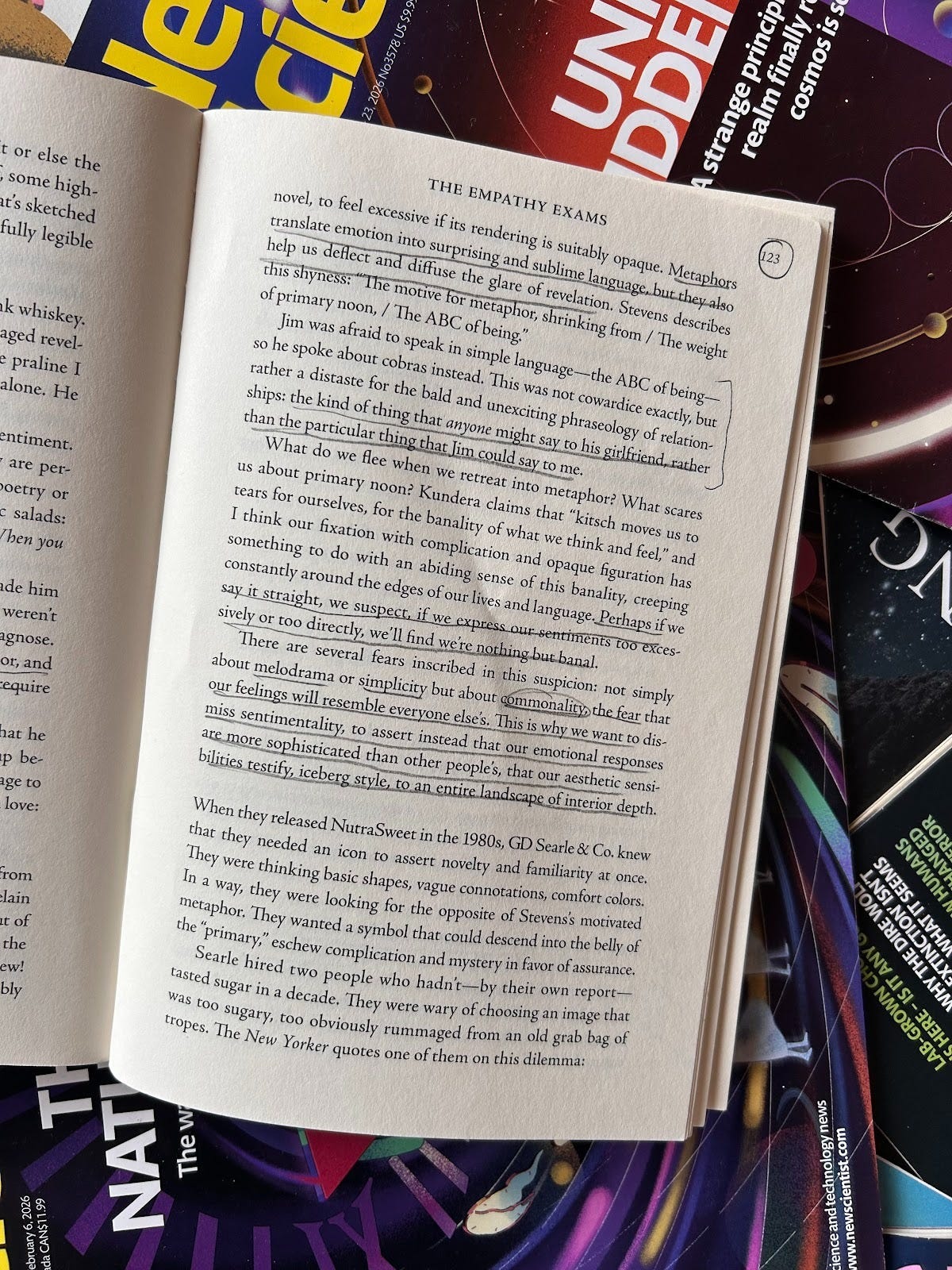
On a second read, “In Defense of Saccharin(e),” is an imperfect essay, structurally uneven and without a strong kicker. I still found myself reaching for a pen to underline many of the sections that I had already underlined back in 2014. The truth at its core still resonated. I lingered on these sentences:
“Perhaps if we say it straight, we suspect, if we express our sentiments too excessively or too directly, we’ll find that we’re nothing but banal. There are several fears inscribed in this suspicion: not simply about melodrama or simplicity but about commonality, the fear that our feelings will resemble everyone else’s. This is why we want to dismiss sentimentality, to assert instead that our emotional responses are more sophisticated than other people’s”
I never made it as an academic, but I became a writer so the fear of being too sentimental or earnest or, as Jamison points out, too banal, never stopped looming over my work and, accordingly, my future.
My debut book, Entangled States: A Life According to Quantum Physics, will be published in a little over a month and it is a book that is both written in first person and in no small part about myself and my feelings, two facts that feed that old fear just like packets of Splenda mixed into bitter tea satisfy a sweet tooth. Of course, a book must be promoted to be successful and make future books a possibility, which is all just another instance of having to cringeworthily say “I want to be a writer” and “I have important thoughts and feelings,” and “will you please listen to me.”
I could couch and restrain some of these desires in facts about society and politics. I could frame them as intellectual and subversive interventions into the literature by talking about how I was socialized as female in a conservative culture, so socialized to be self-effacing, about the historical lack of queer voices in science writing, about the importance of hearing from immigrants and trans people at this particular juncture in American history. This would all be valid. But there is a more banal underbelly too – I want you to hear what I have to say because I think it’s good and interesting. Because I think there’s real connection in letting someone feel big for a moment, and basking in their bigness too.
Whether a book becomes successful depends on a confluence of countless factors and I can only control very few of them. What I can control is how much I let myself be earnest, sentimental, saccharine, cringey, cliche and if not common then at least basic. Remembering just how little the coldness and restraint of academia did for me and how much love and support being shamelessly honest has garnered me in past years, I am trying to let myself be all of those things a lot, and often. After all, restraint is a virtue that was largely imposed on the people that I consider to be my kin; writers and queer folks alike have almost certainly always been a little too much. It’s part of what we have to offer, our gift in this cruel time of irony, weaponized incoherence and machine-generated slop.
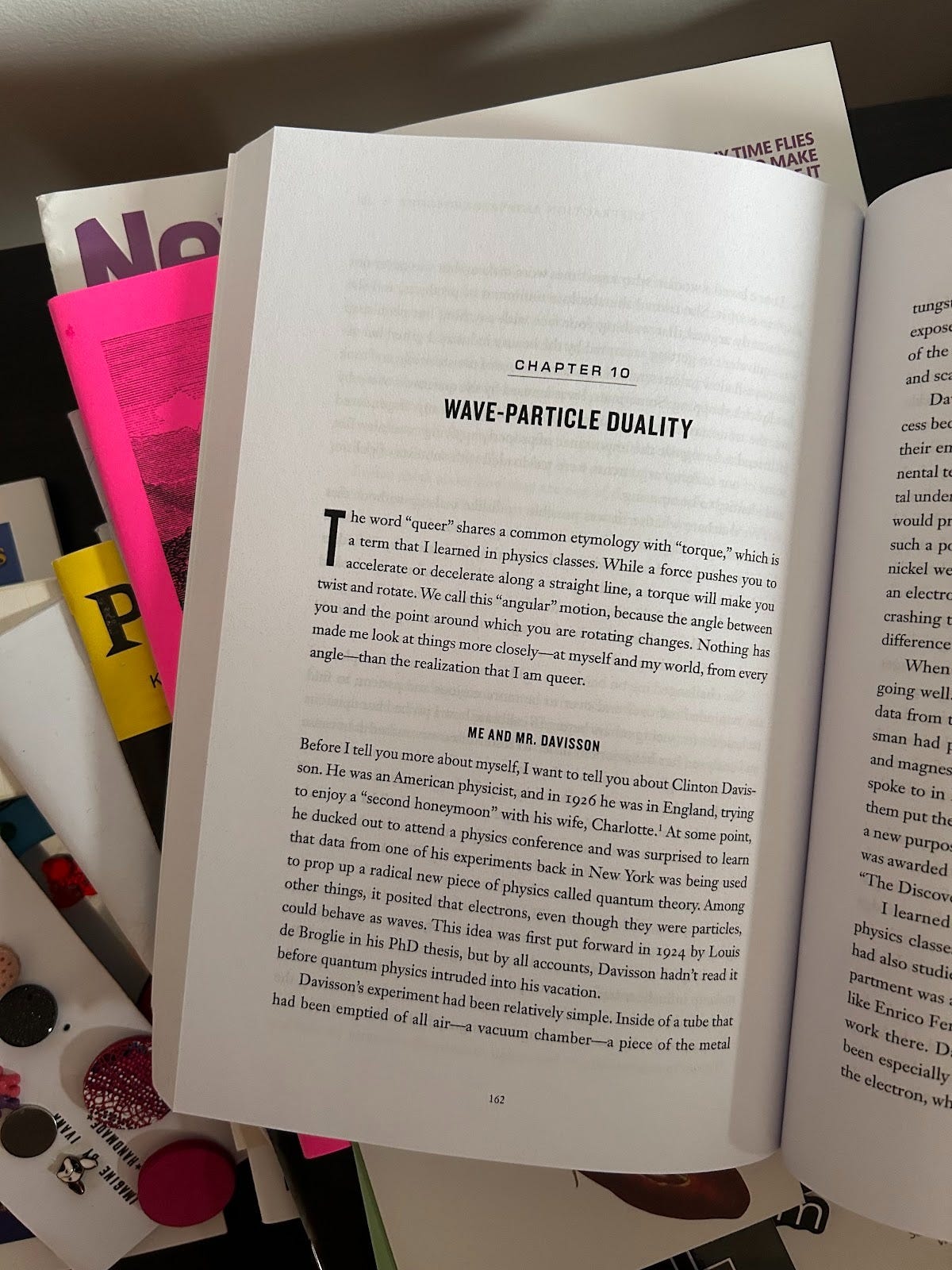
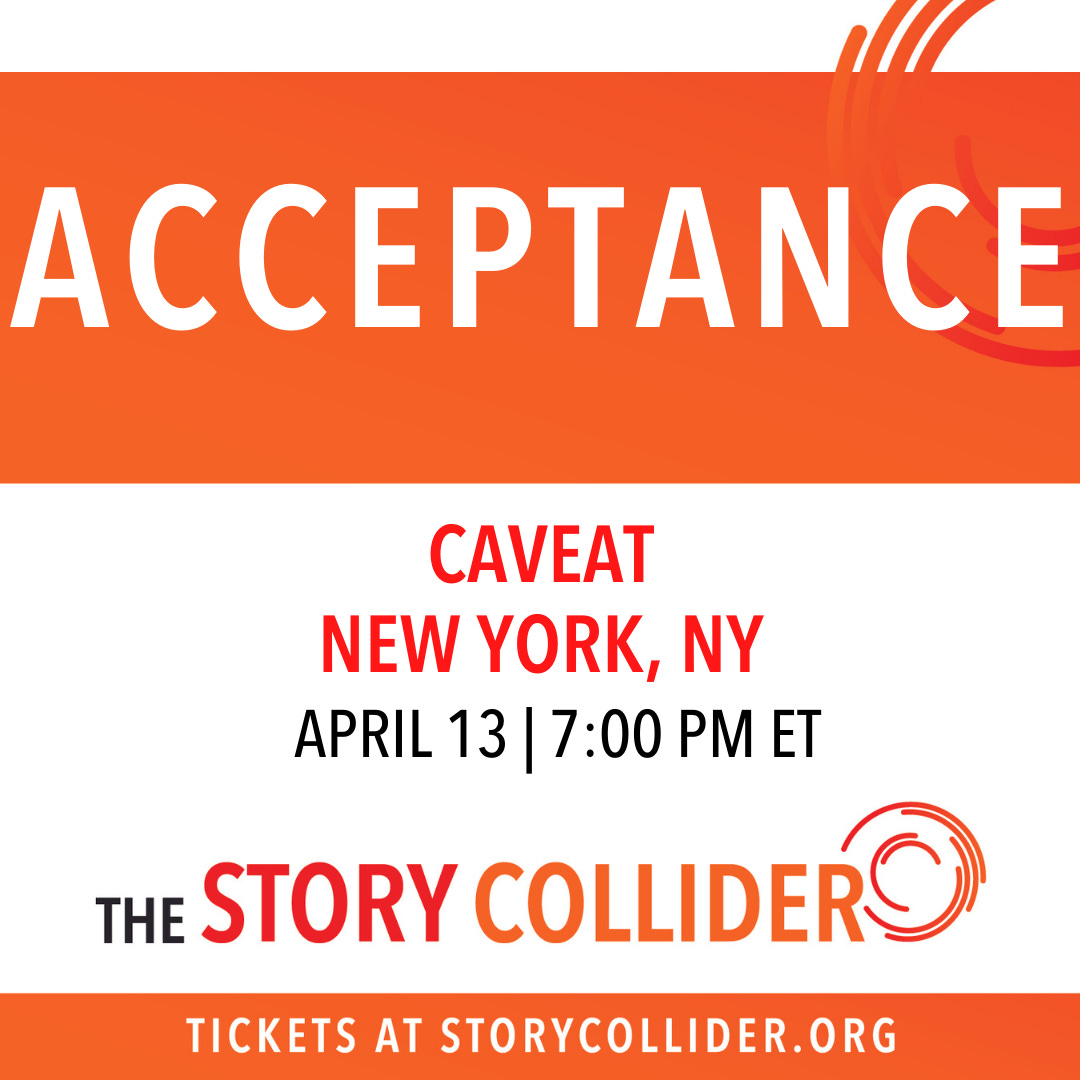
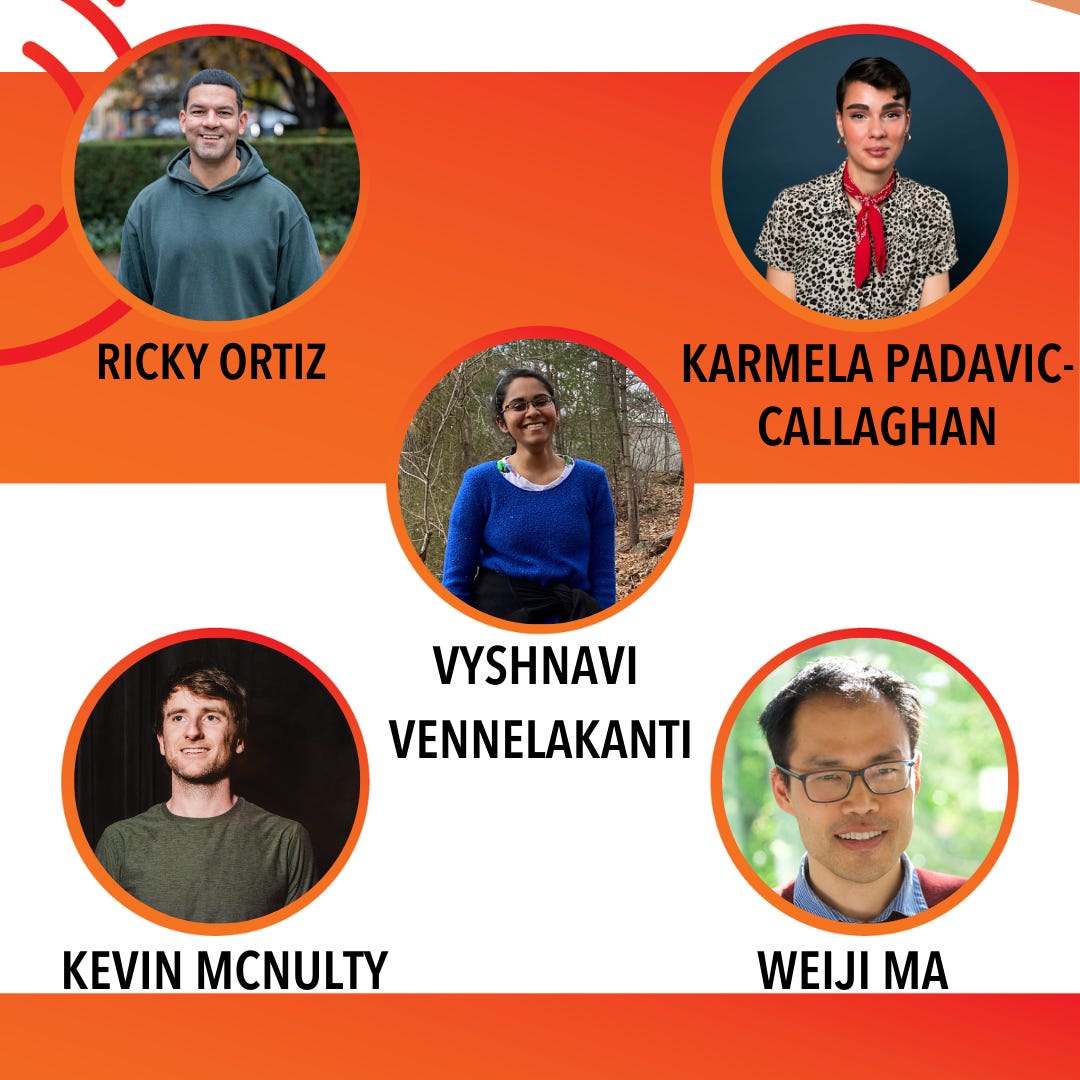
So, on April 13th, I am going to get on stage and tell strangers a sentimental story about my feelings. This will be part of the Story Collider, a series of live storytelling events and podcasts that feature stories that intertwine science and everyday life. The title of this particular event is “Acceptance,” and I will be telling a story adapted from the tenth chapter of Entangled States, which pairs the quantum phenomenon of “wave-particle duality” with my, to use a stock phrase, gender journey. I’ve put a lot of time into making it sound deliberate and coherent, and very little time into trying to make it sound intellectual or detached.
Jamison notes that David Foster Wallace was a famous defender of sentimentality, advocating for writing that was like “big crude crayon-drawing feelings that could actually render us porous to one another.” If you live in the area, I hope you can come hear me attempt the same.
Best,
Karmela
During my masters program, I wondered why, for me, getting through academic reading was akin to choking on cardboard. I desperately wanted to feel smart and I thought that meant being stimulated by consuming dry but rich material that's inherently difficult to connect with. Some years later, my focus has shifted and I unapologetically appreciate sentimentality - it's accessible. Accessibility is connection and we are starving for connection right now.
I'm really looking forward to your book!
I think often about the mandate for objectivity and the way it's been extended as an expectation for scientists to curb their humanity, with all kinds of consequences--ethical and otherwise. The more scientists are courageous in showing the world that they actually have feelings, the better off the whole world will be. Getting super excited about this upcoming book.