
Crystals, Fields, and a Generous Word Count
Behind the scenes of two quantum physics features
Thanks for reading my newsletter! All opinions expressed here are strictly my own. Find me on TikTok, Instagram and Bluesky. Ultracold publishes every Monday and my debut book Entangled States: A Life According to Quantum Physics is now available everywhere books are sold.
CRYSTALS, FIELDS, AND A GENEROUS WORD COUNT
I can’t say that I knew what “magazine writer” meant when I was growing up, but it surely came for me in my 30s.
Technically, I am one. In April, I celebrated four years at New Scientist, which is still printed and delivered to mailboxes in several countries every week, a paper stalwart in a very digital world. But my experience of being a magazine writer in 2026 does not really resemble the stories that have come to be associated with the role. There is very little glamour and affluence, and an awful lot of overtime and unanswered emails. I also work on the news desk, which must have always been the least glamorous part anyway. News reporters write snappy, quick-turnaround stories as opposed to longform pieces, or features, that can justify travel and long periods of contemplation. Features writers get a taste of that famed magazine writer life; I am trying to file a story at 3pm after it was put on my plate while I was still eating breakfast. If there is a Joan Didion or Guy Talese of physics writing, I am not paid to be either. Adrenaline and anxiety are on my menu a lot more often than deep thought or hours-long tinkering with just the right poetic flourish. So, when I do get commissioned to write a longform feature, it’s a bit like being given permission to cross into a parallel universe where my role as a magazine writer really is luxurious in words and meaning alike.
Below, I offer a peek behind the scenes of two of my recent New Scientist features, on whether physics can ever offer all the answers about our world and on the controversial discovery of a long-debated type of quantum matter.
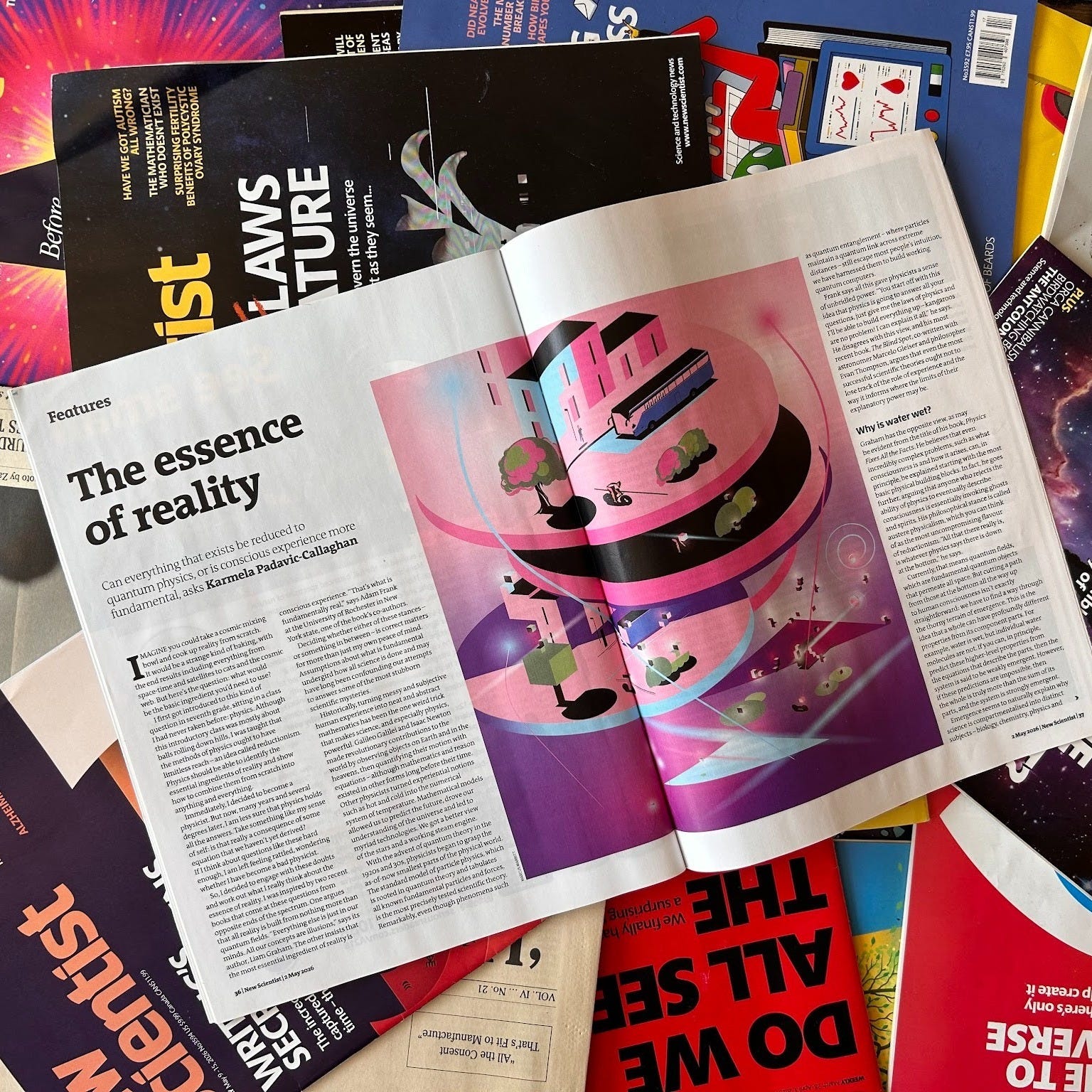
For Liam Graham, the trouble with reality started when he was a teenager. It was books that did it, specifically popular books about physics. He learned about particles and quantum fields and then he got obsessed. Here were the building blocks of physical reality and if you just worked out how the laws of physics dictate that they be put together, you could truly understand everything about, well, everything. How exciting! Then, his teachers at school ruined it all.
Yes, particles and fields described by physics may be the most fundamental ingredients of our world, they said, but the objects we interact with daily, objects that are more readily described by biology or chemistry, are so complex that we may never be able to fully reduce them to physics alone. Graham was disappointed. He went on to become an economist and a writer, but the belief that physics has all the answer – or “fixes all the facts,” as the title of his 2025 book suggests – never left him.
“All that there really is, is whatever physics says there is down at the bottom, quantum fields or elementary particles or whatever. Everything else is just in our minds, just a projection. All our concepts are just illusions,” he told me when we spoke over Zoom, early in the process of writing the feature.
I was sympathetic to Graham’s instincts. I also fell in love with physics by reading popular science books, and I also badgered my teachers about it until they could not stand me anymore. I was as annoying in college and even more annoying after I completed a Ph. D. in theoretical physics. At dinner parties and in the New Scientist newsroom I often argue that physics must be correct even when my friends and colleagues find it counterintuitive, for instance in the realm of quantum phenomena. Yet, the prospect of conceding that all my experiences are illusions because I cannot directly experience quantum particles and fields rattled me. Could it be that I secretly believed in some non-physical ingredient of reality all along, something so ethereal or ghostly that it could escape the science that Graham and I both love?
Ultimately, it was this question that my editor thought was rich enough to build a piece worth several magazine pages around. What were the arguments in favour or against this view, which Graham calls austere physicalism? Was there relevant empirical evidence or historical trends within science? Who might disagree with Graham? And would I please call some philosophers of science and see what they think? I was happy to do all of those things, even if it meant reading several books on a very compressed timeline and acquainting myself with much more philosophical and metaphysical jargon than I am used to. Had I been given twice the word allowance I probably could have filled it up with great ideas, facts, and quotes that came my way during the reporting process.
In contrast, the editing process was tremendously long,1 but what came out of both it and all of my reporting was a piece that put Graham’s austere physicalism in conversation with phenomenology, an opposing philosophical stance that prioritizes human experience instead of dubbing it an illusion. The person who spoke to me about phenomenology was physicist Adam Frank, who co-authored The Blind Spot, another book that I very much liked, and have referenced here on Ultracold in the past. Several other philosophical stances got a shout-out and I am very grateful to philosophers Jessica Wilson, Carl Gillett2 and David Papineau who found time to walk me through them. Their challenge was to catch me up on decades of philosophy of science that simply do not get taught to people that are meant to do science, such as physicists like me. My challenge was to learn that “goings on” was a technical term, how many different types of emergence, where the sum is greater than its parts, there are, and how to say “ontological autonomy” to New Scientist readers without using either of those words. I had lots of fun.
More than two thousand words later, I am still not ready to argue that all that is real is quantum fields and the rest is an illusion. When I think of you, my reader, I wince at the thought that you’re just a quantum field shaped into the form of you by my limited human mind. Yet, I also understand that evidence that would point beyond only physics existing is if not scarce then difficult to parse. It leads you to studies of phenomena like consciousness, which may as well be the most difficult open problem in science today – and one that is uniquely challenging for the tools for doing science that we currently have. Can we put an equals sign between consciousness and its physical correlates in the brain? Or might there be something that transcends physical processes as we know them at play? That and many similar questions keep researchers up at night and arguing with each other.
For my part, I am, for now, content to keep an eye out for what happens next. And I do hope a follow-up feature will be called for in a few years.
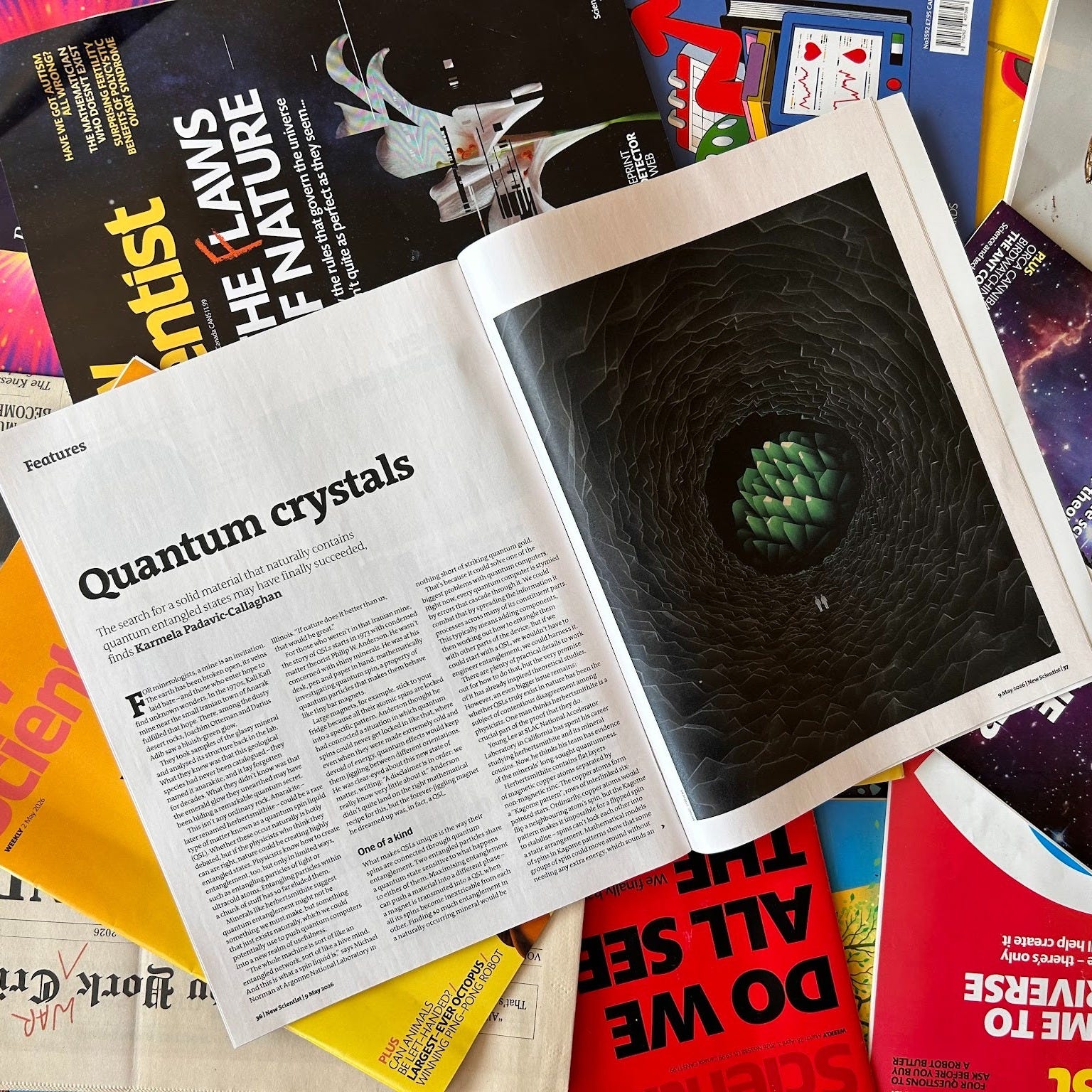
The place where quantum physics becomes the least abstract and the most tangible is in materials or, more plainly, chunks of stuff. Think, for example, about why some materials conduct electricity and others do not. The answer comes down to whether their electrons, or particles that carry charge within them, are able to form rivers that we call electrical currents. But electrons are quantum objects. They must play by the rules of quantum physics. Whether an electron can talk to another electron or run alongside it is a quantum problem. This is why so much of modern electronics secretly runs on quantum phenomena. For example, semiconductors, which are key materials for smartphones, computers and anything else automated or “smart,” are something we could only understand enough to make useful because of the advent of quantum mechanics. Yet, the science writing world is not overflowing with stories of materials or the related field of condensed matter physics. I trained in this field during graduate school so I have an affinity for it, but making stories about matter and materials interesting to either editors or readers is, I learned, difficult.
There are understandable reasons for this. Looking at a chunk of stuff is not interesting unless you already know a fair amount about how stuff works on an atomic and particle level, or if someone can claim with certainty that this is the stuff that will soon start appearing all over your everyday life. The details of techniques that physicists use to look inside chunks of stuff, something that I touch on in my book Entangled States3, are also complex and technical. You may believe me when I say that physicists have a way of looking at a particle inside of a piece of some material, but if I try to explain how, for example, neutron scattering facilitates that, we’d end up in a short self-styled course on solid state physics and crystallography, not a fun casual chat. One way to write a story that side-steps some of these challenges is to zero in on a narrative that can both zoom-in on one character and zoom-out on towards larger question about science. The story of the discovery of quantum spin liquids, which I recently wrote about, had both.
A quantum spin liquid is not actually a liquid. Most likely, it is a crystal, and a shiny one at that. The “liquid” designation refers to the behaviour of quantum particles within it, and how some of their properties always fluctuate, like a liquid that can’t help but always be a bit sloshy. This quantum sloshing is intimately connected to these crystals being filled with lots of quantum entanglement, which is a connection between particles that has no counterpart in the non-quantum world. Quantum entanglement is also thought to be a valuable resource for several emerging quantum technologies.
Researchers know how to entangle particles in the lab, but it is difficult and finicky, and the results are fragile. So far, however, physicists have not found a rock or a crystal that nature has made full of entanglement instead, where entanglement would come for free. A quantum spin liquid would be such a chunk of stuff. Mathematical models of it have existed for 50 years, but whether it actually exists has been an open question that whole time. For more than a decade, Young Lee at the SLAC National Accelerator Laboratory in California has been trying to prove that green crystals of the mineral herbertsmithite, which have at one point been found in mines in Iran and Chile, are in fact a real life quantum spin liquid.
I wanted to tell Lee’s story because I am curious about problems that can hook someone for the entirety of their career. Lee told me that he hear about quantum spin liquids as a young professor and simply never let go, across different institutions and research teams. The sort of passion that can make every one of your days devoted to spin liquids for years on end is what underlies so much of science, but that quiet and patient perseverance does not always get celebrated. There is the myth of the great physicist as the lone genius, a man sitting in a room and having a big a-ha moment. So many researchers, and their teams, don’t fit this caricatured, unrealistic trope, but just keep pushing the frontiers of our knowledge anyway. The work is unsexy and slow, but we all benefit from someone being passionate about it. Materials science and all the technologies that benefit from it could not sustain itself if some researcher didn’t get obsessed with an exotic or odd material on the regular.
But what made the story of Lee and his team and quantum spin liquids even more interesting is that not everyone agrees that his green crystals actually are this new state of matter, despite years of accumulating evidence. This raises a big question – what does it take for a discovery to count as a discovery?
In the piece I wrote, one physicist, Michael Norman at Argonne National Lab, tells me that a “smoking gun,” or one unambiguous piece of flashy and decisive experimental evidence, is what will ultimately tip the scales. On the other hand, when I spoke to the renowned theorist Steve Kivelson from Stanford University, he argued that a web of evidence that grows bigger and denser until the scales simply must tip is how science works more often. For Lee’s part, he thinks his evidence is sufficient and struggled to explain why not everyone agrees when I asked him directly. A lot of it is in the nitty gritty, I learned, in disagreements on experimental techniques that are already state-of-the-art and perfect mat for experts to fight on top of. It was clear to me that Lee was frustrated, and it was also clear to me that he was determined to keep adding clearer and clearer threads to that network of evidence.
To make matters more complicated, from speaking to two other researchers, Hitesh Changlani at Florida State University and Zi Yang Meng at the University of Hong Kong, I learned that materials other than herbertsmithite have also shown promising signs of being a quantum spin liquid. It was not just Lee’s odyssey that could speak to the reality of the theorised material! Is it really then possible that quantum spin liquids don’t exist?
As a journalist, I am reluctant to espouse belief one way or another, but I enjoyed writing a piece that could lay out all of these pieces of the story and give the reader a chance to have their own internal debate on the nature of discovery and the existence of quantum spin liquids. And who knows, maybe their grand-grand-grand children will be using technology that surreptitiously uses a quantum spin liquid crystals alongside semiconductors that are used now.
***
It is such a privilege and a real joy to get to hit ‘pause’ on all the chaos of daily life and spend three or four days at a time diving into topics like this, juicy with all facets of science and philosophy and often deliciously full of further questions. Shout out to magazines, sometimes they really are the best.
Best,
Karmela
Never forget that most journalists are absolutely at the mercy of editors.
While I was reporting, I read parts of Wilson’s Metaphysical Emergence and Gillett’s Reduction and Emergence in Science and Philosophy, both very academic texts, which made me miss college just a tiny bit
Please consider supporting my work by purchasing the book wherever you love to buy books, or requesting it from your library.