
Luminous Spheroids of Plasma
On stories about scientists at the time of (looming) dystopia
Thanks for reading my newsletter! All opinions expressed here are strictly my own. Find me on X, Instagram and Bluesky. I’d also love it if you shared this letter with a friend. This essay contains small spoilers for the TV show Silo.
Do you have questions about science writing or physics? Email me at ultracold.newsletter@gmail.com for an upcoming mailbag issue of Ultracold.
LUMINOUS SPHEROIDS OF PLASMA
What happens to scientists in a postapocalypse? I kept returning to this question as I watched Silo, a science fiction series set in a dystopian future full of judges, doctors, IT specialists and mechanics but, at least over the course of the first two seasons, not a single scientist.
Silo is based on a series of books by Hugh Howey set in a community confined to an underground silo that was built by mysterious “Founders” and is, presumably, keeping the 10,000 people who live there from the deadly and devastated environment outside. As the mayor of the silo explains in the show’s premiere: “We do not know why we are here. We do not know who built the Silo. We do not know why everything outside the Silo is as it is. We do not know... when it will be safe to go outside. We only know that day is not this day.” And there is another twist: 140 years before Silo’s story starts, there was a rebellion in the community and the rebels destroyed all records of its history.
It is unclear why the rebels did this, but in the aftermath of the rebellion, the Silo’s government as well as its judicial and law enforcement arms made it a highly legal offense to possess any relics from the time before the Silo. Under the laws of the Silo, being caught with an old book, for instance, gets you sent to the mines or, worse yet, to the outside where the mysterious environmental disaster kills within minutes. By the end of the series’ second episode viewers learn that asking too many questions about the history or the rules of the Silo will also land you on a list of undesirables so vile that your doctor will conspire with the government and make it medically impossible for you to have a child.
This is where the Silo thrives as a dystopia. Its worldbuilding is immersive and interesting and could easily undergird a more utopian story. For instance, the mechanical and agricultural engineering feats that the Silo’s society leverages to keep thousands of people sustainably living in a closed space for hundreds of years raises a lot of questions about circular economies and food resilience. This sort of self-sustaining system is certainly relevant as we try to imagine a better future in the face of climate change. However, this societal success fades when considered alongside the restrictions placed on the freedoms of the Silo’s citizens. The good of a green burial and endless recycling of gadgets is overshadowed by the draconian repercussions for simply asking questions. The fact that where the denizens of the Silo most lack freedom is in their access to history and information, and reproduction, makes the show eerily resonant with the United States in the time of abortion bans and the government seeking to control the way museums display the nation’s history and comedians tell jokes.
I started watching the Silo on a whim, because I needed background noise while I stretch or strength train after running and the TV happens to be in the only room in our apartment where I can fit a rolled out yoga mat. I struggled with the first episode, which felt long and heavy-handed, I got curious about what may happen next when the second episode packed in several truly unexpected character twists, and by the third, when the edges of both the big and small puzzles for the season started to come into view, I was fully hooked.
This is not to say that Silo is perfect. The fact that its class hierarchy neatly maps onto its architecture so the lower the level you live on the lower your socioeconomic class and the less luxurious your life, is all but subtle. The show’s protagonist, Rebecca Ferguson’s somewhat butch mechanic Juliette Nichols, follows the trope of a reluctant hero very closely and seems to be physically indestructible. There are several wife characters that are underwritten in a disappointingly familiar way. Common, the rapper, has a major role, but only has one emotional note that he hits in almost every scene (and hits it hard). But the show is action packed, every episode ends on a cliffhanger and Ferguson plays despondent rage very well. It’s the sort of middle road captivating and entertaining TV that seems to have fallen through the crack in the age of chasing prestige TV at all costs. And I kept wanting to see whether we’d ever meet a scientist. Certainly, if the big bad of the show is an environmental disaster, someone will think to attack it as a matter of scientific inquiry, I thought. What tool could be better here than good old empirical science?
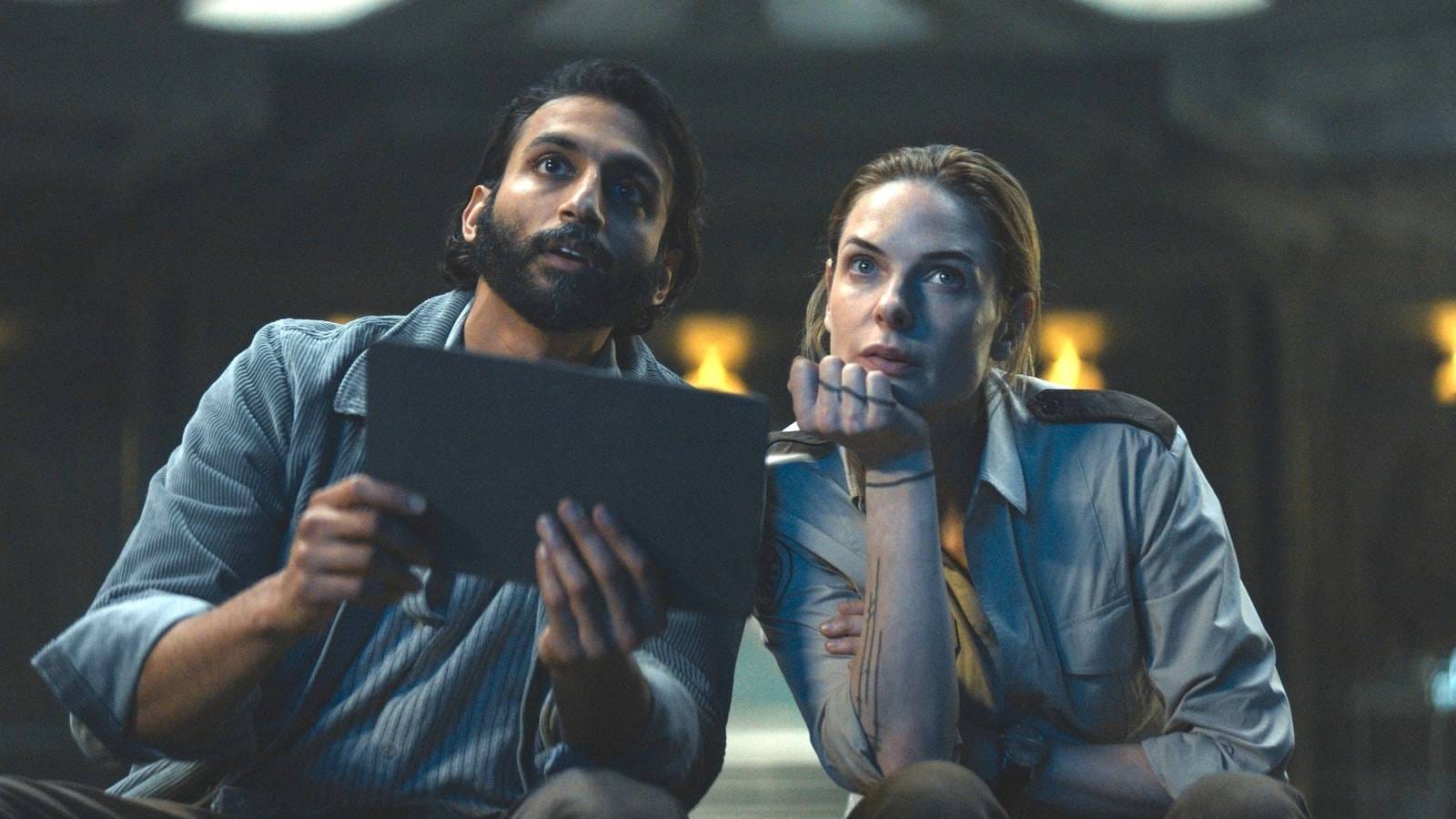
The closest the Silo gets is when it introduces Lukas Kyle. Kyle works in IT but spends his nights in the cafeteria that has large outside facing windows. He tracks the lights in the night sky and discovers patterns in their motion. He is, albeit slowly, rediscovering the basics of astronomy. In the show’s second season, Kyle correctly conjectures that it is the Earth that is moving, not the lights in the sky. It’s an “eppur si muove” moment of sorts, down to the fact that Kyle lays out his theory just as he’s about to be sent to the mines. Fittingly, this is punishment for a crime related to access to information - Kyle did not snitch on someone who was hiding a hard drive from the before times. Eventually, he learns that the lights in the sky are called stars and that they are "perpetual balls of fire.”1 His curiosity is satiated, but he pays a cost for it: having to collaborate with the show’s villains, the same people who control the flow of information.
Everything about the story of the Silo eventually comes down to who is allowed to seek knowledge, which is the fundamental work of science. In Silo’s dystopia scientists are so dangerous that their work seems to be forbidden. This is even more clear with the character of Juliette’s mother, who is punished for inventing a magnification device that allows her to mend the heart of a sick rabbit. The device embodies the sense of curiosity, and the power to find out facts, that the Silo’s rulers just cannot allow. And without curiosity there cannot be any science.
It is also notable that the shows’ class commentary is most pronounced when the story focuses on a community of mechanics who live in the Silo’s lowest levels. They maintain and operate the generator that makes life in the Silo possible, which gives them the most material and mechanical power over their society yet, politically and socially they have none. Viewers are repeatedly told that all past rebellions either started in “Mechanical” or were blamed on them. Folks in Mechanical also exhibit the most class solidarity, they have each other’s backs the most and they work to redistribute wealth when they face adversity.
They are heroes because they have the technical knowledge that quite literally keeps Silo’s society functioning, but they are not discoverers or theorists, nor do they conduct experiments. The same goes for the Silo’s doctors who mostly seem to be in cahoots with the government, lying about birth control to the young and overly inquisitive and keeping them under sedation when those rebellious types become elderly. And then there is IT, arguably the most powerful department in the Silo, and the one that, spoiler alert, turns out to be the home of the show’s most overt villains.
Instead of providing technology that will enable citizens to access or process information, IT is all about restricting access to it and surveilling who knows what and how they learned it. Only the highly ranking officials in IT have access to books and only they know what really happened with that famed rebellion from 140 years ago. They are, in this way, the opposite of what you may imagine scientists ought to be like. Instead of asking questions, the IT bigwigs make it impossible, or illegal, to answer them.
What is a society like when it does not include any working scientists? In the case of the Silo, the semblance of peace enforced by authoritarian behaviors like making history inaccessible does not last because some character or another never gives up on asking their questions. The lack of information, the prevention of understanding, the outright ban on curiosity, they all lead to unrest and the edge of societal collapse. Season two of the show, its latest, ends in the middle of a proletarian uprising. And everyone saw it coming.
No one in the world of the Silo tells stories about scientists either. All the heroic tales of uniquely intelligent men (and almost always men) who sat under apple trees or imagined themselves riding atop beams of light have been forgotten and they don’t seem to be part of the population’s imaginary. This is another strongly dystopian facet of the series, the abundance of technology which is crucial yet impersonal, paired with the absence of stories about who figured out how to make it, why it works, and how its inventors got there. It is hard to not see echoes of this tendency in how some of the most buzzy technology of the day, such as Large Language Learning Models, are sold to the public as “black boxes.”
I am never going to advocate for telling the story of science as the story of anything but team work, but a society in which the archetype of a scientist, as flawed as it always is, is missing struck me as a newly terrifying concern. If the archetype of the person who asks questions and solves puzzles, and gets to be celebrated for doing so successfully, is replaced by someone who tinkers with machines or controls information, can their society fall into anything but cycles of stagnation and violence?
It is tempting to argue that the United States is currently moving in the direction of the Silo when it comes to attitudes towards science and history. Ideologically-driven cancellation of research grants at even some of the most powerful research and education institutions, budget cuts for agencies like NASA and the NIH, lists of words forbidden in academic grants and, in some cases, publications, interventions into museum curation, these are all moves that those in power only make with the goal of not only restricting access to information but making that information less relevant than the population’s compliance.
Fields of research that are underfunded or defunded now will have to fight extra hard to keep their place in the literature. Many researchers whose grants got cancelled a year into a project that was planned to run for several years will disappear from their discipline’s history and many of their questions and ideas will likely be forgotten. Many might end up at for-profit companies where whatever they do learn about our world through theories and experimentation will end up locked away from the public as proprietary information, as something that their bosses will use to turn a profit.
Devastatingly, scientists are already rewriting the stories of their own science out of fear of retribution. For instance, several of MIT Technology Review’s Innovators Under 35 told the magazine as much, with Eileen Guo and Amy Nordrum reporting:
“Many have changed how they describe their work in order to better align with the administration’s priorities—fearing funding cuts, job terminations, immigration action, and other potential retaliation. One person who works in climate technology said that she now talks about “critical minerals,” “sovereignty,” and “energy independence” or “dominance” rather than “climate” or “industrial decarbonization.” Another individual working in AI said she has been instructed to talk less about “regulation,” “safety,” or “ethics” as they relate to her work.
When someone in the future looks back on what was being studied and published about, who will they think counted as a scientist right now? Who will they deem as having been doing legitimate science based on their ability to secure funding? To be more blunt, when a government goes out of its way to underfund or fire all researchers who happen to be people of colour or researchers who study gender or climate change, it is signaling to people of the present and the future that they don’t consider that work to be scientific, that there is not truth to be discovered by asking those questions. Or at least what the government wants to declare to be the truth.
Describing the workers at his AI start-up in July, Elon Musk recently asserted that “There are only engineers. Researcher is a relic term from academia.” Musk’s disdain for academia is part of a performative anti-elitism, but the choice of pitting “researcher” - someone who asks questions - against “engineer” - someone who builds a machine with a fixed purpose - is in line with building a society where there is no room for curiosity and questioning. Musk also seems to be a little obsessed with how well his company’s AI can do on physics exams, a testament to how physics’ tendency to analyze the world after breaking it into most basic building blocks can lead the wannabe rulers of the world to think that the truth about physical reality is just another engineering problem to be conquered with a machine.
I wonder whether Musk’s ideal world looks a lot like the world of the Silo, with engineers that keep everything going and lords of information at the very top. Of course, this world is already being shoved down our throats every time a Google search produces an AI-generated summary followed by sponsored results. This world’s prospects are certainly looking good whenever someone tells me that I would understand just how helpful AI could be for my journalism work if I just put more effort into “prompt engineering.” This world lurks at the edges of press releases advertising advances made by “AI scientists.”
I don’t want to fully dismiss the notion of something in the ballpark of artificial intelligence eventually being useful for scientific research, as another tool in the scientist’s belt. But the voices that are shouting the loudest are telling a different story, and it’s one that is getting uncomfortably close to a tale where scientists get replaced by people and machines who are more compliant and less curious. I can imagine it, the same ads that tell me it is more frictionless to order my groceries than interact with the human person at the checkout counter at the store could eventually try to sell me a more frictionless vision of doing science.
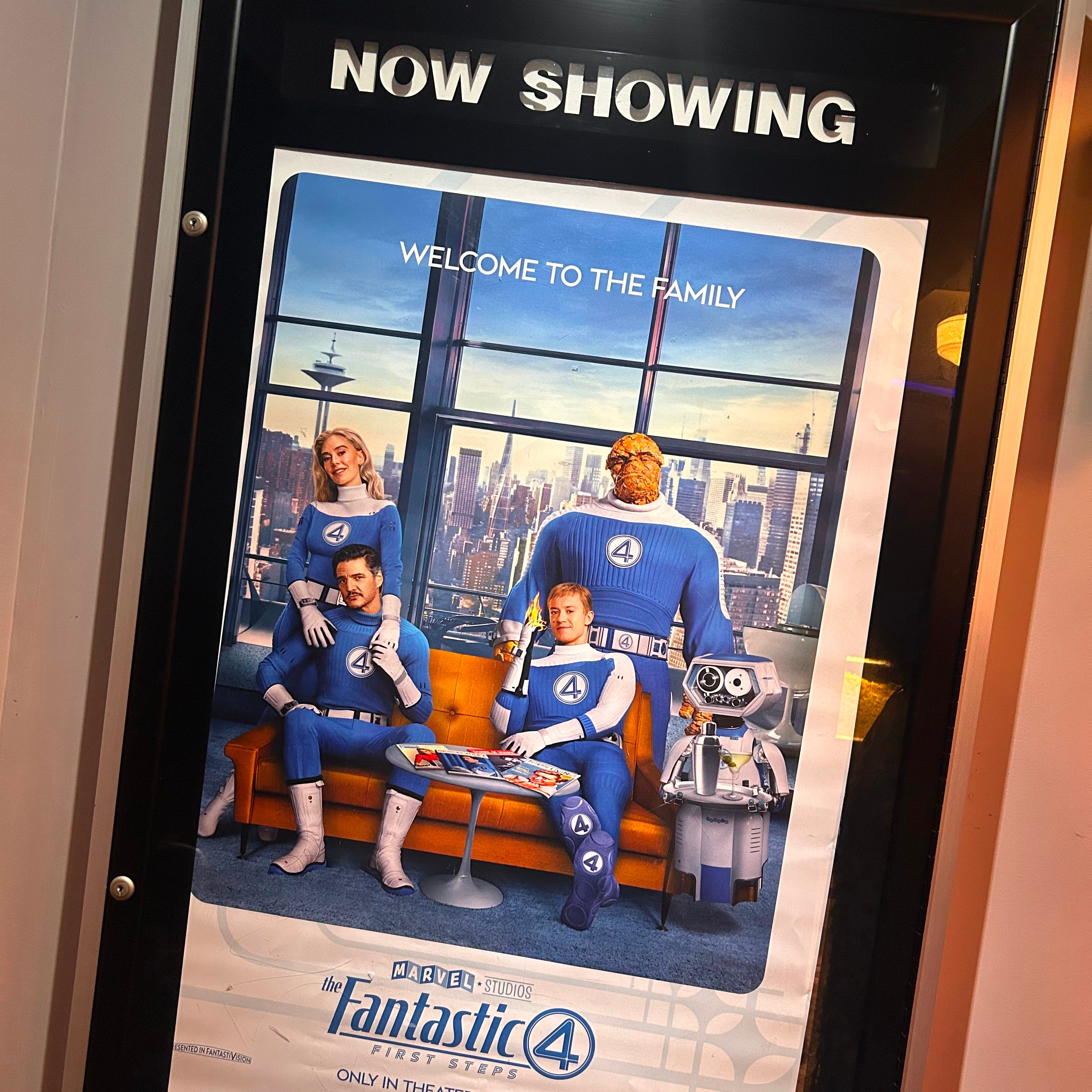
Unlike the Silo, Marvel Studio’s most recent shot at making a pop culture comeback, the star studded The Fantastic Four: First Steps, prominently features a scientist.2 Not only is Reed Richards canonically the smartest man in the multiverse, but he is also played by the Internet’s favorite cool, slutty daddy Pedro Pascal. As Richards, Pascal gets to make a lot of faces that signal that he is either thinking very hard, very concerned, or both. He deals with the anxiety of having a newborn by devising a machine that will measure and scan everything about the baby. When the Earth becomes threatened by a cosmically large villain, Richards turns to quoting Aristotle and writing equations on a blackboard. This is all to say that Richards here is such a potent mix of tropes about scientists that I really could not imagine not understanding that “scientists” is both his profession and his identity.
Richards, the scientist, is not exactly the film’s main hero, but he is repeatedly shown calculating something and all other characters seem to take it as a given that his approach - the scientific approach - is the one that will show them how to save the Earth. In fact, at one point, everyone in the whole world cooperates to bring one of Richards’ ideas to life. In this fictional world, the scientist character is credible and beloved enough to make that happen. But we also get to see his profession and skillset framed as something dark.
This is most notable when his wife, Sue Storm, reprimands his scientific process for thinking through every scenario, including those where the solution involves lots of suffering. “Sometimes... Sometimes you being you hurts me,” she says, and who he is is a thinker and a scientist. The film pins this to a specific moral dilemma, but I found the implication interesting more generally. Storm’s comment has echoes in the real world in the stories of real scientists who crossed ethical lines, but it also contains the seed of a growingly familiar distrust in science.
Here, considering too much information, asking too many questions, weighing too many probabilities is enough for a person to cross into harmful behavior. Because Richards can imagine a dark scenario, he is under suspicion of wanting to make it real. Too much thinking, too much desperate curiosity, is framed as potentially morally corrosive. This reminded me of the way that aspiring populists and pseudo-science grifters talk about scientists, about how they imagine them all as secret villains, sitting down in dark rooms to take money from shadowy industries or formulate the next “mind virus” to be unleashed on children.
Those who subscribe to this view argue that you have to “do your own research” because those that have done theirs already only chose to do the most corrupt thing with it. What else could you do with critical thinking and quantitative reasoning skills than something evil? It is a real failure of science as an institution that its practitioners, heroes and champions have not managed to turn this question on its head and imprint all our minds with the possibility that knowledge and curiosity can be used for good. It’s the sort of failure that makes it easier to conjure and build a world where there are only mechanics or engineers.
And there are legitimate caveats when it comes to speaking in defense of science, the biggest one being that the discipline became professionalized and corralled into institutions in a way that is inextricably tied to capitalism and all of its ills. Historically, scientists have been complicit or active participants in colonization and inflicting harms on already oppressed and marginalized groups. Today, many research labs sustain themselves through military funding. On top of that, academic departments are increasingly run like businesses so the pace of discovery is set to the tune or grant deadlines regardless of whether nature will allow that or not. There is a strong push towards quantifying every field and handing the reigns over to the consultant class. Predatory degrees and predatory journals are in no short supply, and institutions that I have previously mostly known as hubs of great research such as the University of Pennsylvania, Columbia University and Brown University have all entered into settlements with the government that effectively trade their independence for federal funding.
There has always been elitism in academia, it has always been a racialized and classed space, but even professional intellectuals that had previously had the privilege of claiming to be apolitical are now having to confront just how much politics have shaped the conditions of their work. To add insult to injury, turning academic research into an exercise in project management and hunting for start-ups that can be spun out of academic labs has also given rise to celebrity academics that wholeheartedly buy into the myth of individualism.
The stories of hero scientists from the past were problematic as vectors of the “lone genius” trope, but at least Albert Einstein didn’t have a podcast, nor did Niels Bohr ever try to hawk a protein bar. It is not a coincidence that some of the people making the most deadly decisions about American public health right now did once earn degrees and hold legitimate academic appointments. There is less and less in the structure of academia that would encourage scientists to stick around and follow their curiosity and do truly creative work - but the opportunities to monetize science-washed information are ample in some corners of the sciences.
For a while, this mostly applied to biomedical and health sciences but this past week the Wall Street Journal ran an article titled “The Rise of ‘Conspiracy Physics’” which suggests otherwise. The article is imperfect and has little to say about the physics part of ‘conspiracy physics” but the fact that a publication that does not just focus on science saw a trend among physics streamers, podcasters and YouTubers concerning enough to run this story is in itself troublesome. The article mostly recaps a conflict between three physicists, one a tenured professor and two independent researchers, which started on, of all places, a show hosted by Piers Morgan.
Two of them argued on Morgan’s show, the third chimed in on YouTube later, and all three have massive media platforms. To be fair, they did argue about physics fundamentals, but the argument also centered on the idea that working within academia means churning out papers for the churn’s sake, that there is “an establishment” that is the real problem here, not just the fact that physics is, well, hard.
As is the case with all conspiracies, there is some truth to these criticisms, but it is also undoubtedly true that there is more money in yelling about physics being dominated by “groupthink” than by allowing those criticisms the complexity and nuance that would make them generative and productive. In the age of Trump 2.0, when the party line is that all institutional scientists are to be distrusted by default, this type of online yelling also, purposefully or not, aligns the yellers with those that are truly in power, not in the shadows but in the increasingly gilded White House.
Between the conspiratorial anti-science sentiment and the genuine shortcomings of institutions where science is done, is there still hope for the scientist as not just a professional but a character in the story of how society does, and ought to, function?
As a working science journalist I ask myself this all the time. Part of this concern comes from working for a for-profit company where my job is not just telling interesting science stories, but rather science stories interesting enough to convince readers to give money to my employer. The importance of telling stories about science and informing the public about cutting edge research is largely not seen as high enough for science journalism to be a public good, so it has become an industry like any other. The pressure to produce news articles that are easy to understand rather than nuanced (and scientific research is, by default, always nuanced) and “news you can use” rather than stories about less practical work driven by curiosity is very real and requires people like me to soul-search constantly. It’s the sort of thing that keeps me up at night.
At the same time, doomerism about our media ecosystem, even in the relatively small niche of science journalism, feels a lot less helpful than the occasional sleepless nights. To put it simply, I still think that stories about science and scientists are worth it. But to avoid a dystopian future we have to think about them differently.
Defenses of science that only frame it as something instrumental, as a tool for creating profit or technological dominance over America’s adversaries are not narratives that can save it. I have always taken pride in physics having once been natural philosophy which means that my lineage as a physicist starts with people that were asking the biggest questions there are, that were the most curious, that asked questions about facets of the cosmos and reality that were once relegated solely to the gods. To me, this is the story of science that will always be worth telling, the story of just wanting to know, of finding new ways to understand the world being key for making our lives richer.
We should tell this story more. And we should be more honest about where academic science falls short, not to discredit it but to open room for changes and fixes. This will be complicated, and difficult, and imperfect, but those adjectives also describe the current situation, and that situation does not seem to be leading anywhere good. Institutions and their current structures are not inevitable, and I don’t think we should act like they are. In the same way that we ought to flex our imagination muscles and conceive of ways to repair harm without putting people in cages or offer healthcare without extracting value from human bodies, we should look towards a future where science does not have to be tied to gatekeepers, hierarchies and forever auditioning to be the next best tool of the empire.
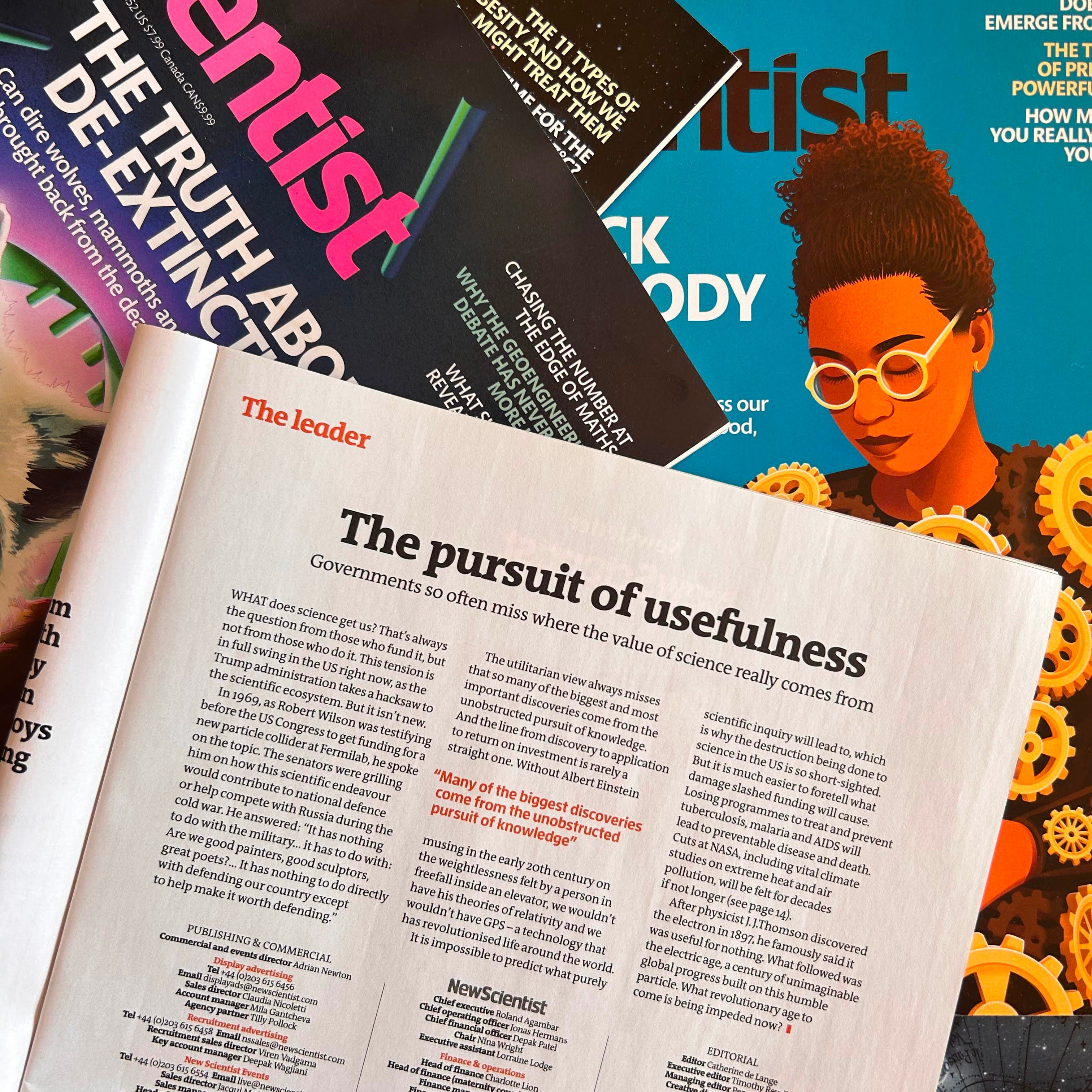
In 1969, physicist Robert R. Wilson testified in front of Congress to argue for building a particle accelerator at the Fermi National Accelerator Laboratory (Fermilab) in Illinois. There is a famous moment in the testimony when the democratic senator from Rhode Island John Pastore asked Wilson how the accelerator will affect national security and the scientist replied:
“It only has to do with the respect with which we regard one another, the dignity of men, our love of culture. It has to do with those things. It has to do with, are we good painters, good sculptors, great poets? I mean all the things that we really venerate and honor in our country and are patriotic about. It has nothing to do directly with defending our country except to help make it worth defending.”
The accelerator was built, on time and under budget, under Wilson’s leadership. Somewhat ironically, he resigned from his post as Fermilab’s director only 8 years later as an act of protest against insufficient federal funding. Budget cuts to national labs have been back in the news this year, but framing of scientific discoveries as the sort of societal good like painting, sculpture and poetry, has absolutely not. In my view, this is a mistake.
I spend hours talking with researchers every week and I start most of my interviews by asking some fairly open-ended question about what brought them into the work that we are discussing. Many of them have had to write formally about their research goals and motivations for journal articles or in grant applications yet they still often slightly recoil at the question. A hint of “How can you not see that this is just interesting?” flashes across their eyes before they launch into a story packed to the brim with passion and curiosity. I think I’d be pretty useless in the world of the Silo, but many of these folks would certainly be rediscovering astronomy in the cafeteria every night. I hope we can not lose sight of how this drive is really what it’s all about.
Best,
Karmela
The title of this letter is the more jargon-y way of saying this.
This was fun to think about, thanks for the post.
Scientists are threatening in a dystopia for obvious reasons. But as I was reading, I couldn't help but think they can also be frustrating for people who care about improving the world; taken to the extreme, the pattern-seeking, truth-seeking, curiosity-driven personality is more interested in what's real (and often only a tiny corner of what's real) than what's good, which is something that's kind of beyond science. Basically, science on its own can say what is, but not what should be. Dystopias often rely on lies or secrets, like the one you describe in the Silo, so just pointing out the raw facts of the world is subversive in that context. But current circumstances really show the limitations of scientists thinking they can just stick to producing facts without engaging with what those facts ~mean~ in the context of human morality and society.
loved this! silo is one of my fun shows, and i read the books because i was impatient to wait between seasons… the flaws you point out in the show are soooo much worse in the books 😅 that being said, there’s so much in the show and books that definitely overlaps in provoking ways with what’s happening now!