
Thanks for reading my newsletter! All opinions expressed here are strictly my own. Find me on TikTok, Instagram and Bluesky. Ultracold publishes every Monday and my debut book Entangled States: A Life According to Quantum Physics is now available everywhere books are sold.
This Pride month, please consider donating to an organization such as the Trans Youth Emergency Project, the Transgender Law Center or the Sylvia Rivera Law Project, or directly, materially supporting a trans person in your community.
ELECTRON
It’s the end of Pride month and I’m mostly tired. It’s not because I celebrated too eagerly, but because of that other thing that gets queer people — having to work to pay rent. My June has been marked with traveling to conferences and staying at the office late to chase deadlines much more than with partying or protesting. This might as well reflect our times. Much more than being culture issues, queer issues are those of survival and economics, from finding employment to being able to afford healthcare. As those things get harder for everyone, which is the case in the United States right now because our government is committed to war, supporting genocide and isolationist politics, those of us that still have pronouns in our email signatures are not at all immune. Social media algorithms have recently been showing me lots of commentary on how ‘everyone was nonbinary’ only when that was trendy and lucrative1, and yet here I am, still nonbinary, still living in a way that feels barely stable financially, mostly tired. But I am also still very proud.
No matter how much the world tips into crisis, the sense of freedom, possibility and unboundedness that comes from being queer remains, and remains a source of power for me. Queer and trans people can reimagine the world in the same way we can reimagine our bodies and relationships, we can name structures that narrow us down or oppress us and simply recognize them as unneeded and worth leaving behind. Liberatory politics and queerness share so much DNA, and if Pride is a party and also a protest then it might as well also be an invitation to say this part out loud. I kept experiencing this in recent months as I’ve been promoting my book Entangled States,2 which had me interacting with queer readers and supporters in various rooms and corners of the internet. Some readers had questions about the physics in my book, but a lot of conversations ultimately turned to systems level thinking and working towards societal change. In the book I tried to write about my model of the world, informed by physics and my lived experience, but most discussions that the book spawned were about a model, and then a reality, that we could build together instead. This filled me with both pride and hope.
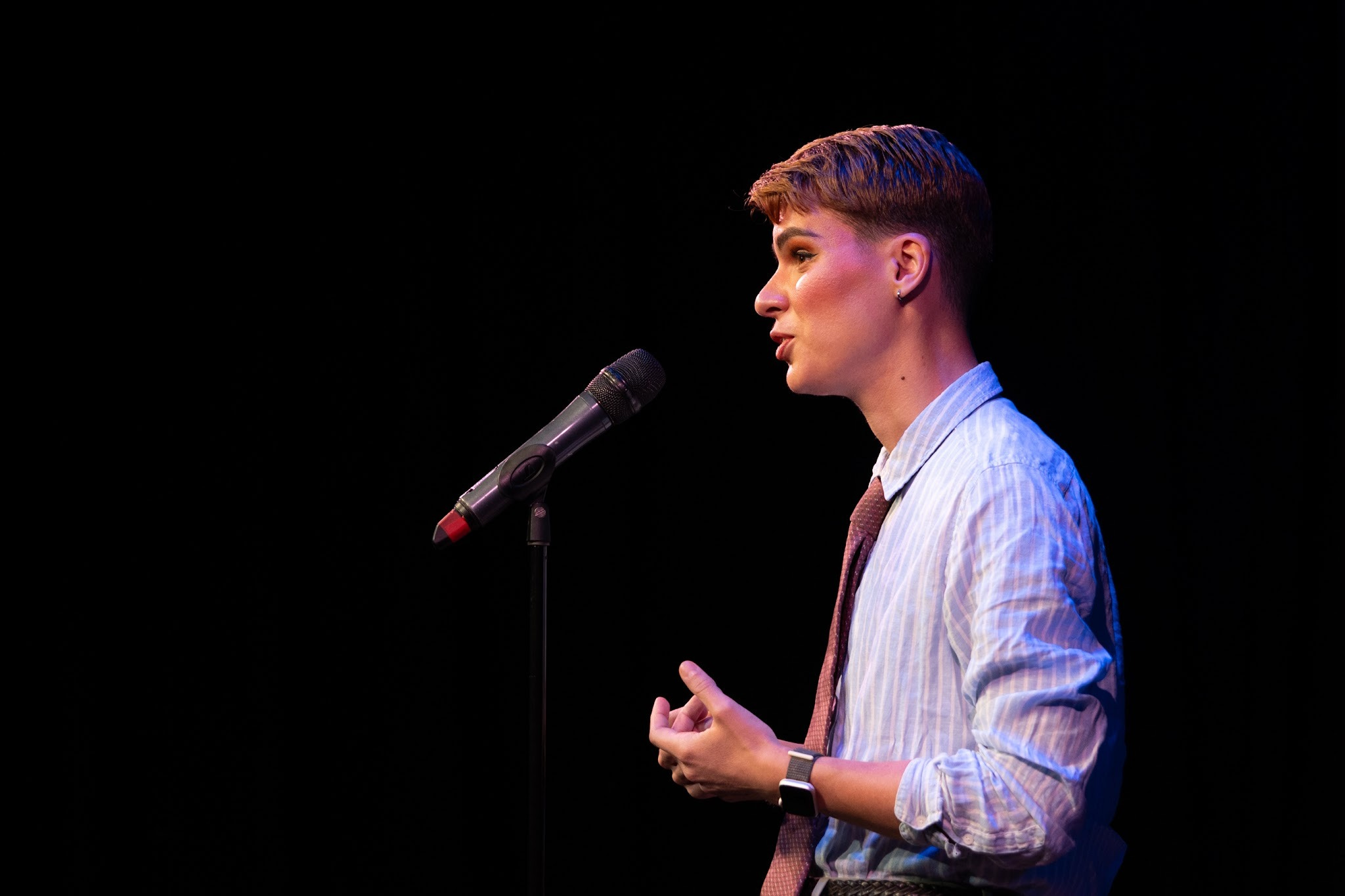
Below, I am sharing the transcript of a piece I performed at the storytelling event Story Collider in April, which was the unofficial start of all of my relentless talk about Entangled States. I adapted one of the chapters for the occasion, the one that deals with my path toward transness and nonbinary gender. To a large extent, it’s a story of how I got free and how my community helped me get there. It was incredibly intimidating to speak it from a stage, and to have to do so from memory, but the response was encouraging and warm. Later, sitting at a pizzeria with some of my best friends, sharing vegan garlic knots and yapping about everything from best places to get gender affirming care to tips for memorizing poetry, I felt grateful to have not denied myself a chance to live a queer life. It’s a life I’m a little more proud of with every passing year, and this, luckily, extends way beyond the hubbub of June.
Physicists love to categorize things. There are categories for particles, for mathematical objects, for types of matter, for atoms and molecules, and so on. I learned about this in the seventh grade and immediately decided to become a physicist. I liked all of my classes, but physics, with its neat categories, rigorous equations, and so, so many rules for how the world ought to work was the one that took my heart.
It promised me that the world was understandable. As a teen, an overeager mess of curly hair swaddled in oversized Iron Maiden t-shirts, I could imagine the universe as a finely tuned mechanism and physicists were the people who would figure out the role of each of its cogs. Learning physics felt like learning how to read a secret code and the message was that our universe was not scary or incomprehensible.
I reasoned that you could make sense of nearly everything by determining an object’s category, then finding equations that describe that category’s behaviour, then solving them to learn everything about that object and its future. The worst that could happen was that you could be bad at math, but that felt fixable. To play it safe, in college, I would choose math as my second major, in addition to physics.
While I knew that I wanted to be a physicist very early, other parts of who I could or should be didn’t come so easily. How to be a woman, for instance, was a mystery. Until middle school, I was a tomboy, the kind that played in the woods and got upset when someone gave them clothes for Christmas. But as I grew older, my father, whom I idolized, started informing me that women should be soft, shave their legs and never be as loud as a man. The implication was clear, I was to become a woman, and these were my instructions.
Though my father’s statements may seem shallow or just aesthetic, they alerted me that a point would come when the two of us would become irreconcilably different. I never thought that I was boy and would become a man, but what I awaited as I entered puberty still felt like a huge transformation. I thought I’d wake up one day and have that thing that my dad was talking about, that thing that I could see my mom already had. There was something at her core that always shone through regardless of clothes or make up. Surely, I would eventually be graced with it too.
As an older teen, still waiting, confused about the whole thing, I read up on feminism and learned that there is no one way to be a woman, that women came in all sorts of types and that it is possible to feel empowered once you both found your flavour of womanhood and built solidarity with other women. I kept trying to find my flavour. Dressing like my favourite European heavy metal bands wasn’t helping, but neither did it help when I wore long dresses and corsets as a goth, or pencil skirts like a ’50s vamp, or even when I cut my hair and consciously flirted with butchness. It all felt like cosplay. Throughout that time, I learned a lot of trigonometry, then calculus, and also Newtonian mechanics, and Maxwell’s equations, and thermodynamics, but how to feel like a woman remained mysterious.
When the time came to learn quantum theory, I was determined to be a hot girl. I sat in lectures about quantum objects and uncomfortably stared at chalky blackboards in a tight dress and sticky lipstick more than once. What I was learning, however, was stunning. In quantum theory, objects do not always have fixed categories, what you can say about them with certainty is limited, and predicting their future is a game of probability. Despite being a long-time lover of categories, I found myself more enticed, more enchanted, more excited about physics than ever before.
There’s one particularly striking example of quantum category breakdown. It goes under the name “wave-particle duality.” Being a particle, maybe an electron, means having well-defined edges and being your own chunk of stuff. Being a wave means extending as far as there’s stuff that you can ripple upon, like a wave on the ocean’s surface. The two had always been considered to be mutually exclusive. Then, in the 1920s and 1930s, both physicists who worked in labs with actual electrons and physicists who solved equations explaining electrons’ behaviour discovered that this just wasn’t the case. The electron was revealed to be both a particle and a wave and, somehow, also neither. Different experiments had already established that light was the same. Other basic building blocks of the physical world followed.
I went to graduate school to study the quantum world in more detail and my sense of internal unrest tagged along. I dressed extravagantly throughout this time, pre-emptively drawing attention to myself before someone could ask any questions about who I really was. It was fun to dress up, and a lot less fun to notice that whether I was crunching equations in track pants or teaching in a dress, I still felt like I was not like the ‘real’ women I saw around me. And they seemed to not even be trying!
The word non-binary was introduced to me while I was in school, long before I used it for myself, usually in university rooms reserved for meetings of students that begrudgingly accepted the label “underrepresented.” But even when I organized some of those meetings as a graduate student, I considered this word from a distance, unsure of whether it was threatening. I wanted to support peers who had found a home in it, but, ever an overachiever, I kept thinking that I really could crack womanhood. My professors also scared me with the “real world” that was presumably waiting to chew me up as a fledgling scientist, and I was convinced that that world would only accept me as a woman.
And so, I found myself at the edge of thirty, a physics PhD and a good teaching job in hand, going to sleep every night in the first apartment me and a great love of my life rented together under the bright lights of New York City, puzzled by how no amount of growing up or success managed to make me feel properly womanly. A little voice lodged itself in the back of my mind. “Are you ready to lie to everyone for the rest of your life,” it said. “You know you are lying to everyone, right?” I was ashamed, and the life I was building felt fraudulent. It felt like, at any moment, my skin would dissolve to reveal an ugly, pulsating question mark that had no place in polite society.
Here’s the big thing about the inhabitants of the quantum realm. A non-quantum object has an objective truth that maintains itself independent of how or whether you’re looking at it. How you interact with a quantum object, on the other hand, influences what you find. For the electron, in some experiments, its wave-like nature becomes apparent. In others, its particle-like character is more evident. But when left on its own, the electron is sort of existentially fuzzy, unconcerned with being just one thing.
Some physicists may object to this. What the electron is and what we know about it are two different things, they might say. And an electron has no personality and no self-perception. I, however, did have self-perception, and maybe too much of it. Interacting with other people, instead of silently spiraling in my own head, then proved crucial.
New York didn’t leave me with a whole lot of silent alone time anyway. It brought several non-binary people into my orbit and, free of anxieties of school, I observed their lives with more curiosity. No one could accuse them of just being confused kids or academics who read too much. They had rich lives filled with love and hobbies and went to work every day like everyone else. They didn’t carry themselves as people that had failed to solve something, but rather as people who had worked out how to be more free. Some of them became friends and, from up close, in them, I started to recognize a new kind of existential fuzziness.
Life in-between genders could be so mundane and so bright at the same time. I stopped wanting to solve myself and resolved to just be. The distance between me and the notion of “non-binary,” started to diminish, and so did that voice in my head. My fears felt smaller now. Something within me unclenched. “Non-binary” felt less like an idea, and more like a material truth. I told my partner about it, I told my students, I told my friends. Life kept going. It actually became less wobbly, less at risk of suddenly disintegrating.
Now I also better understand why quantum physics had me so enchanted. The quantum objects that refuse to choose whether they are particles or waves offered me a first glimpse of how someone like me could be possible. My friends did not make me non-binary, but they made it feel safe for me to accept that I am. Looking to the quantum world made that acceptance feel unexceptional.
There are more than billion billion billions of electrons in my body, so this not-particle-not-wave and I will never experience the world in the same way. But I find it reassuring that, at least in theory, there are instances where its identity seems to be indeterminate. Although “non-binary” is sometimes flatly represented as something of a third gender in media, I understand it, and I feel it, to be a spectrum of these indeterminate moments—of existing without having to answer any questions, free from searching for truth beyond an inner feeling that is inexplicably mine. If this mode of being is allowed for the electron, it’s hard to see why I could not also claim it for myself.
Best,
Karmela
Whenever people bring this up, I’d really love for them to offer some examples. Enriching yourself by claiming a marginalized identity is something that only really works if you’re already set up for it.