
Quantum or Queer
Has studying physics helped me accept my queerness?
Thanks for reading my newsletter! All opinions expressed here are strictly my own. Find me on TikTok, Instagram and Bluesky. Ultracold publishes every Monday and my debut book Entangled States: A Life According to Quantum Physics is now available everywhere books are sold.
QUANTUM OR QUEER
When I started writing Ultracold in 2017 I promised that it would be, in part, an exercise in keeping me honest, and the intervening years confronted me with the difficulty of what that actually looks like. There is being honest with others, there is being honest with yourself, and there is discernment about when writing about either becomes self-exploitation or a risk to your own stability. But I wasn’t thinking about it so carefully back then. Several years into my Ph.D. work, just exiting my mid-twenties, searching for a sense of solidity after a tumultuous end of college and the early burst of graduate school excitement, I was mostly trying to write myself into existence.
Whenever I was ready to confront or accept a new part of myself, whether it had emerged in connection with someone else or simply confronted me from within myself, I transcribed that revelation as best as I could. Readers who have followed Ultracold from its inception have witnessed me grapple with my identity as a scientist, with my path away from Croatia and towards being a permanent resident in the United States, with a move to a big city, saw me get married, change jobs, and find new communities and hobbies. Among the most stark changes, I rarely wrote about being queer in Ultracold’s early days, and now it’s hard for me to disentangle queerness from any of my writing.
It’s not that I wasn’t queer all along, but the process of understanding that, naming all parts of it, accepting them all, and embracing them as a guiding light was lengthy. I knew that I was bisexual in high school, and my experience of girlhood and womanhood had always felt off, but a feeling does not necessarily imply understanding, nor does knowing something equate to accepting it. I had to grow and grow up some to get there, as a person and as a writer.
Being both a writer and a scientist made me singularly attuned to how important it is for words to mean something, to be the final item on top of a solid foundation rather than a coat of paint covering something that may otherwise be wobbly or only assembled halfway. There is a sort of tyranny of exact definitions that exists in both professions, for better and for worse. Also, there is shame, judgement and danger that exists for people deemed as different in the world at large. So when I call myself queer and trans today, and when I apply the same words to my writing, I only do it because after all of these considerations it still feels true in my bones.
I recognize that it is a reflection of my privilege that I could make my life and writing more queer over the years without facing material danger. Many of my queer and trans kin can’t say the same and the political climate today is one of constantly increasing hostility towards our communities. Despite often being labelled a “culture war” issue, legislation that touches queer and trans people concretely changes their lives, there is nothing abstract about it. It’s not a dispute about what a TV show means, it’s a matter of keeping folks alive. It’s a kitchen table issue for us as much as affording groceries or rent is – access to gender affirming care, for instance, is a matter of survival and pursuit of happiness. So, while my material conditions are as favourable as they are, the honesty I was after in 2017 feels like an even more pressing mandate – and one that includes being loud.
Physics, my first love and the discipline that has marked all of my work and career paths, has historically been dominated by straight and cisgendered voices, or at least voices that were presented as such. If you search for queer physicists throughout history, you mostly find caveats about how we really can’t be sure about nearly anyone because the norm was to stay quiet and afraid. Sally Ride, for example, who was the first woman in space, was revealed to have had a long-term female partner only after her death.
Can you imagine an alternate history where one of the first things humanity carried into space was the sense of freedom and expansiveness that comes from being queer and one where we celebrated that? Of course, that is speculative, but a fact that I can always firmly argue is that space, in fact our whole physical reality, has always had queer bones anyway.
Recently, I attended an event where someone off-handedly mentioned that queer people for some reason always tend to be drawn to quantum physics. Why is that? Expounding on this is one of the throughlines of my debut book, Entangled States: A Life According to Quantum Physics. I write about it based on my personal experience as much as my training as a theoretical physicist.
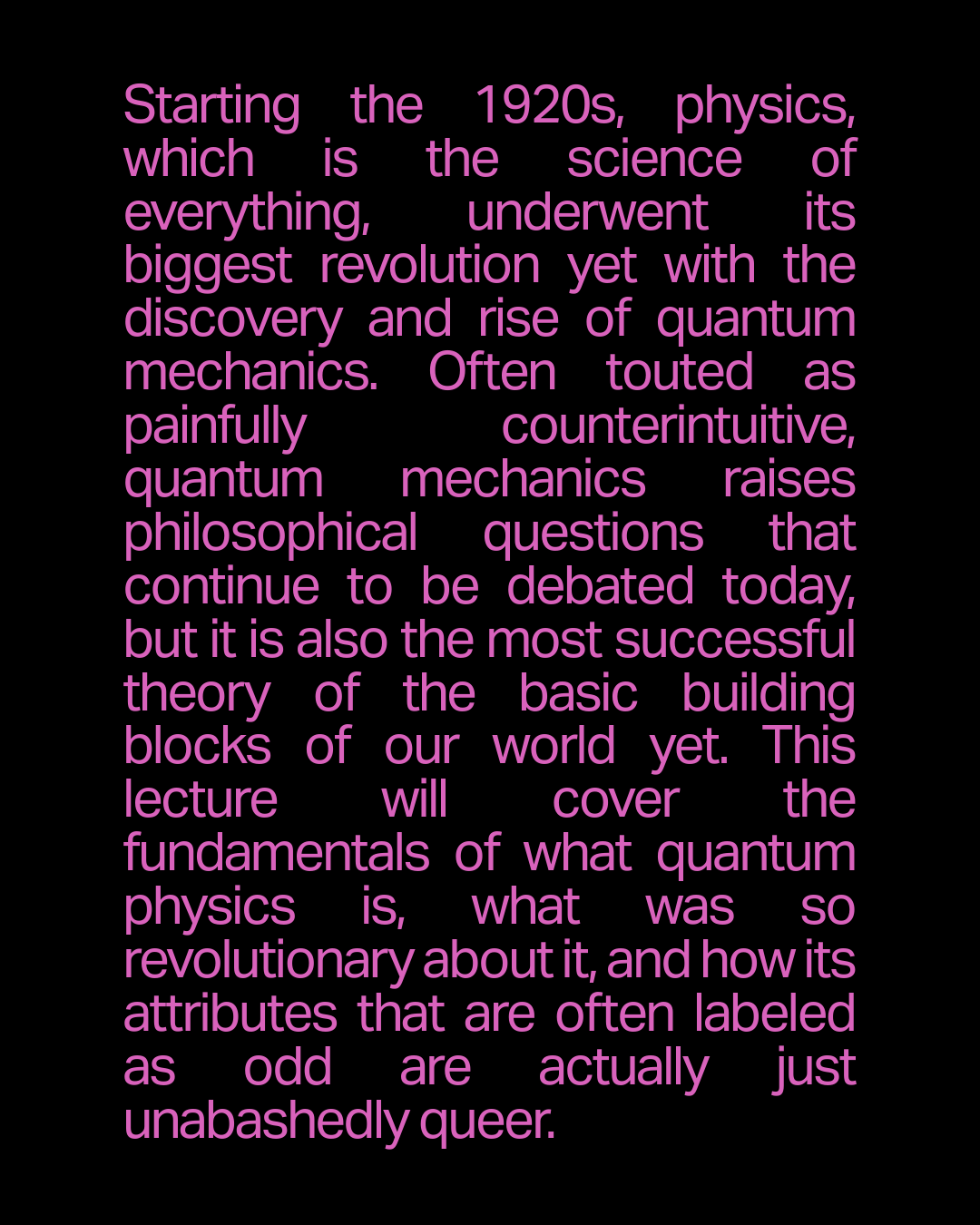
Arising in the 1920s, quantum theory was always shocking, unexpected, and challenging, maybe even avantgarde. Many physicists immediately found it to be philosophically unsavory; they resisted the way that it seemed to be changing not just how physics is done but what physics is for and what it can do. Quantum theory alerted them that perfect certainty and the ability to make perfectly reliable predictions about the future are simply impossible in the realm of quantum particles and fields, which comprise our world at the most granular level. They had to confront the fact that physical reality seems to be built from objects that cannot be fully pinned down, and whose fates always include some element of expansiveness and possibility.
I’ve spent most of my adult life thinking about this. I read about it in popular science books, I formally studied it in school, I researched its implications through original mathematical work, I taught it to high school and college students, and I interview other physicists about it most days of the week now. It never fails to sound at least a little queer to me. In fact, as I write in Entangled States, in learning about quantum theory I found a lot of permission to think of myself as a lot more normal or natural than society lets queer kids and adults feel. Particles that are also waves helped me accept being non-binary. The multiversal interpretation of quantum theory gave me perspective on years of code-switching through different situations, while the famous Schrodinger’s cat experiment spoke to my anxiety over being called out as improperly American and Croatian alike, a situation relatable to many immigrants. The list goes on, and you can explore it all in my book.
Some of these connections are idiosyncratic to me, but I believe that this mode of reasoning is available to anyone, that learning the story of physical reality ought to always include some insights about the self. Because physics is taught and talked about as cold, rigorous, mathematical and so difficult that only a select few have what it takes to engage with it, and because many physicists shy away from psychology, metaphysics and social sciences in general in the fear of marring some mythical objectivity of the field, this process is and feels inaccessible to a lot of people, and especially queer people who are often confronted with hostility and conservatism in hard science departments and similar spaces. My project with Entangled States is, in part, to offer a counterweight to this.
I am not famous nor has my physics work ever been all that significant, but I am queer and physics, and quantum physics specifically, has changed my life in a way that I can’t extricate from my queerness. I offer myself, my story and my writing as a data point that quantum is queer. I’m also not the only or first person to argue this,1 but arguing it without reservations is the most honest thing I know how to do – and it contributes to the picture of physics and queerness that has historically been sadly scarce.
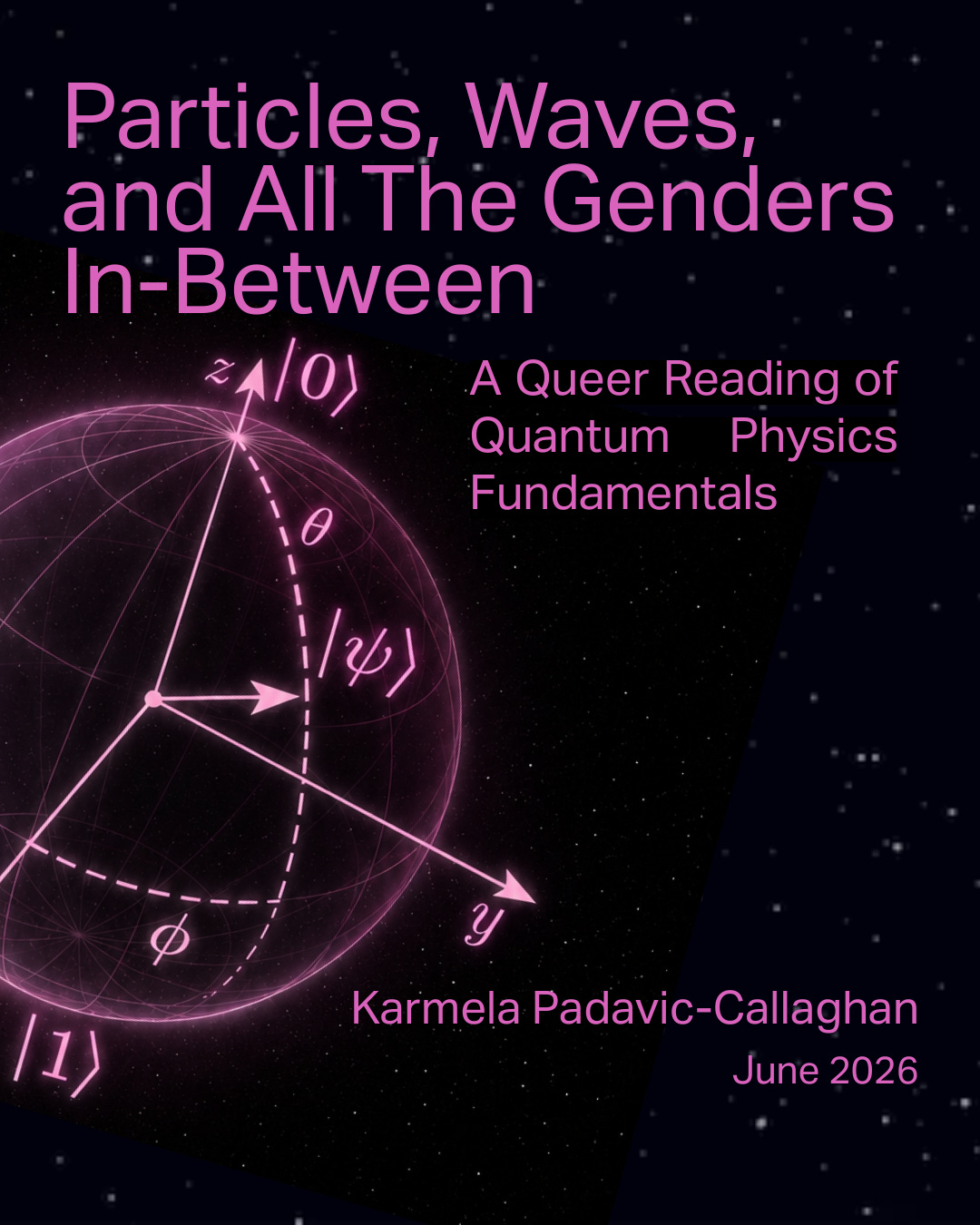
On June 11th, I will be speaking about quantum physics and queerness at Living Room Lectures in Brooklyn, New York. If you’re based in the New York area, I hope you will try and snag a ticket.
Best,
Karmela
The idea of relating particles’ multiple physical states to gender diversity that has been extremely influential on me was first introduced to me through the writing of Chanda Prescod-Weinstein (her recent book The Edge of Space-Time: Particles, Poetry, and the Cosmic Dream Boogie is a delight), and the work of the British-Iraqi drag prefomer Amrou Al-Kadhi