
Quasiparticle
On stitching together all levels of reality
Thanks for reading my newsletter! All opinions expressed here are strictly my own. Find me on TikTok, Instagram and Bluesky. Ultracold publishes every Monday and my debut book Entangled States: A Life According to Quantum Physics is now available everywhere books are sold.
QUASIPARTICLE
During my time as a high school teacher, I had to learn the steps of the scientific methods so that I could teach them to my students. I found this disorienting because I had spent the previous eight years learning how to do and also doing research in theoretical physics and so I thought the steps should be intuitive to me. But the world of physics textbooks presents an idealization, a sort of cartoon of a philosophy that underlies science, and the real world is a lot more complex.
The first step in the textbook world is to make a hypothesis. In the real world, a hypothesis ought to be motivated by something, either gaps in prior theory work or an unexplained empirical observation, but you also have to decide on the level of detail and the form that your hypothesis will take. I actually never really formed hypotheses, even though I trained as a theorist. Working with more senior physicists, I mostly identified questions that could potentially be answered through relentless crunching of equations.
We asked questions, we searched for answers, and whatever we got was almost by default novel and interesting. Any small step you could take to make the unknown more known was worth taking. How me and my collaborators went about actually doing that, however, was, looking backwards, a little mysterious. We’d just kind of follow some hunch or latch onto some technique that had worked before and hope for the best. It was more intuitive, provided you had trained enough to build up intuition first, and frankly more messy than how textbooks later told me it all should’ve gone.
I am still interested in this process, the process of discovery and meaning-making, so in my current role as a science journalist, I often ask researchers how they knew what minimal ingredients their theory will need, or what mathematical or laboratory tools would be absolutely essential to their studies. There’s something both very methodical and erudite and also human and personal about the answers that I end up typing into my notes as we talk. Searching for truths of physical reality is ultimately a creative process more than a matter of following some formula. Recently, however, I heard a physicist give one broad piece of advice that struck me as important.
If you’re working from an empirical observation, he said, it’s crucial that you carefully decide what the most useful level of description is. We actually do this all the time in everyday life. When I pour water into a glass, I don’t have to know that it’s made from atoms, I can think about it at the more macroscopic level of a fluid and still understand when it will overflow onto my counter. When I talk about my friends or community, however, it is useful and good to remind myself of each individual person, rather than think of some amorphous blob of meshed personalities that only engage in group thinking.
And so, the question of process. Once you make an observation and want to convert it to meaning or knowledge or discovery, you have to posit something about it, ideally something that will beget an action – or at least you ought to ask a really good question. This could be in the lab, on the page, or in any other context. Then the question of levels and scales comes in. When can you squint and let it all blur until only the largest patterns remain and when should you find a magnifying glass of sorts and account for every tiny constituent part of the corner of the world that you’ve gotten caught up in?
***
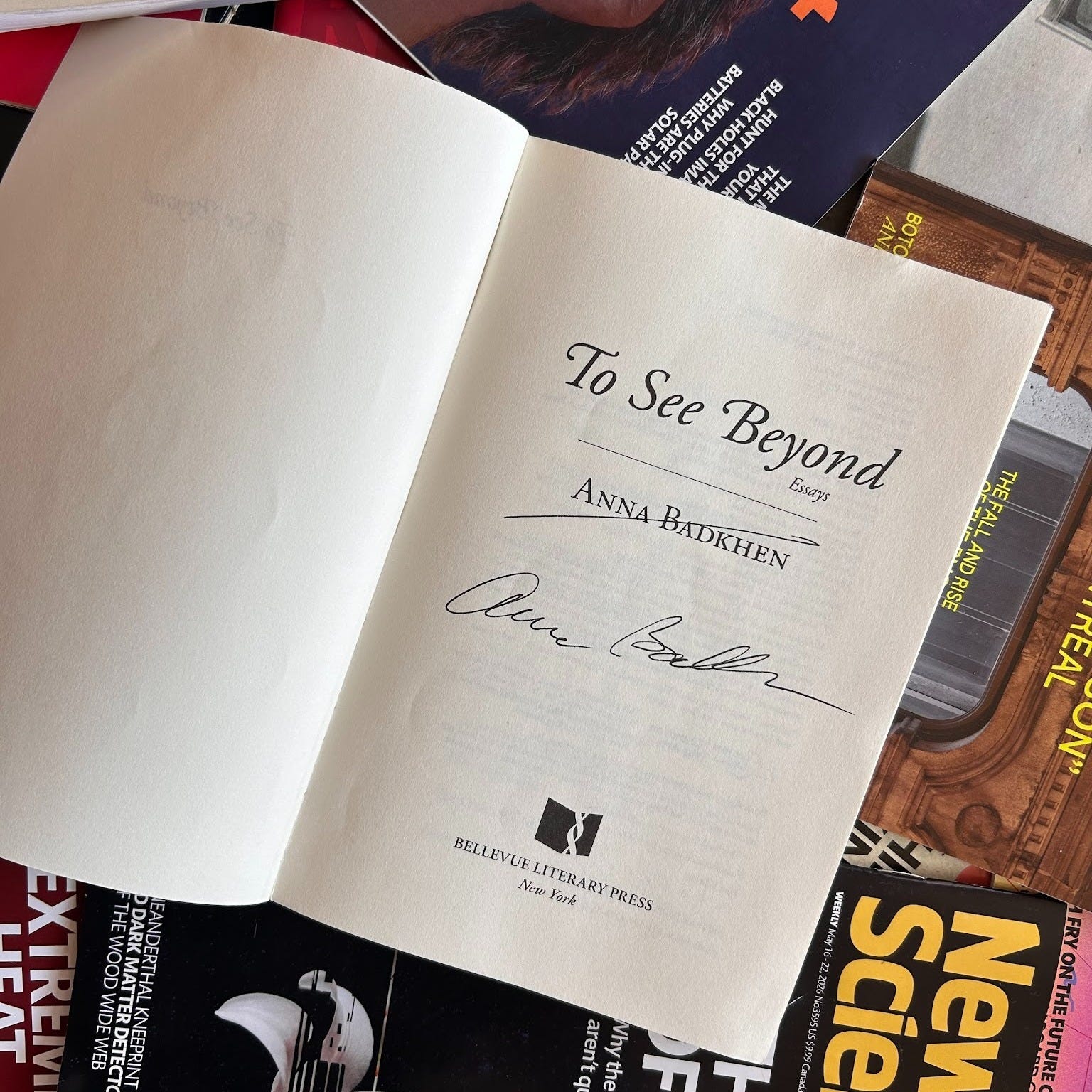
At the very beginning of her book of essays To See Beyond, Anna Badkhen states the questions that drive the rest of its pages:
“What is our responsibility to one another and to this depraved world, and how do our individual relationships tether us to hope? How do we dream, how do we reach for what we can build differently? How do we love accordingly?”
They’re big questions and, much like the rest of the book, leave no scales of reality unexamined.
A longtime war correspondent and a child of the Soviet Union, Badkhen is well qualified to speak on depravity of the world. She has seen cruelty and she has known grief. Throughout the book, she travels from country to country, sometimes meeting her biological family, often meeting those that have become her family while she collected stories and observations of their world. And she is certainly a sharp observer, her writing simultaneously lush and lyrical and also unapologetic about not looking away from cruelty and ruin. Not climate anxiety but a stern acknowledgment of the climate disaster we have brought onto ourselves permeates the book. Small moments of love and transcendence do too.
Above all, she is a questioner and To See Beyond teems with unanswered queries, some in genuine search of an answer, some as the only appropriate way to give voice to a feeling. Repeatedly falling into a practice akin to science, she asks questions at the largest scale and also the smallest one, zooming out from herself to talk about our whole planet, and digging deep into the archeological bones of our world and the very foundations of our language.
A physicist may have the privilege of choosing what level of description is most useful to them, but as Badkhen aims to see into humanity’s heart and maybe even our future, she cannot dismiss any level of thinking, observing and asking as less useful. Even when she squints, the underlying microscopic truths are bound to come on the next page. On one page, the whole universe is captured in the shape of a fresh tortilla and its expansion under the pressure of a rolling pin. This mirroring, this stitching of scales, the fractal character of it all, is among most powerful features of the book.
“When we do atomic physics or chemistry, we do not need to take into account the mass of the top quark,” said that physicist whose lecture I liked. Quarks are one of the two particles that make up our whole world at the most granular scale, at the very bottom of the hierarchy from big and intuitive to small and fundamental. “I have heard people describe experiencing deep prehistory as looking into a bottomless well; I wanted to read it the way one reads tea leaves,” writes Badkhen about visiting the Afar Triangle, a place where tectonic plates are pulling away from each other. If she were a physicist, I imagine she’d never fully forget about how we only exist because quarks barely ever pull away from each other.
One things that happens when you play with levels and scales in some areas of physics is that you encounter emergence. A somewhat notorious concept among philosophers of science, it has one very simple iteration in the world of materials and condensed matter physics. It goes by the name of a “quasiparticle.”
On the face of it, a quasiparticle has all the properties that a particle has: it is localized, it can be assigned a mass and a speed, it can move around and interact with other particles, it can carry charge or energy. But the quasiparticle is not fundamental like a quark is, it is more like a few sports fans doing a very tight wave than an individual with their own free motions and personality. In other words, a quasiparticle is an entity that emerges once more fundamental particles conspire to make it exist, a bit like three kids in a trench coat but if they were really, really good at impersonating an adult.
One example is a “phonon” or a particle of sound, a sort of chunk of vibration that emerges in materials. (“Phonons are not actually real. They are really just a way of simplifying a very complicated problem,” physicist Jon Goff told New Scientist in 2016.) Another is a “magnon” which is magnetic in nature. Physicists know that these objects are not the most ontologically real particles, but at some levels of experimental and mathematical investigation, it’s useful to sweep this concern under the rug. They’re not real-real, but real enough to comprise an understandable layer of the world. You can pretend that ontology doesn’t matter if you’re building a device and just need it to be very quiet to work. I’ve spoken to physicists about manipulating and banishing phonons, about detecting signatures of magnons and their cousins “spinons” in experiments, and even “holes” which are crucial for making semiconductors in our electronics devices work are technically quasiparticles.
A world of emergent, not-quite-real objects can be remarkably useful. So useful in fact, that you may forget that another layer of reality lies below, that our brains just tend to be remarkably good at adjusting to a theory that is most efficient and effective in the moment. Condensed matter physics, a happy home for the whole zoo of quasiparticles, is, after all, one of the most successful branches of this science.
***
I personally struggle to strike the balance between squinting and zooming-in. When I consider the world around me at its most granular, the very seconds of my day, the extremely unique and idiosyncratic personalities of my loved ones, each bite of my food and each note of my city’s din, the foundations for life that they comprise seem so solid, even good. When I zoom out and squint to see what emerges, however, the picture becomes darker, less filled with love and hope. I see patterns of war-making, of exploitation, of fear-mongering and scape-goating, of genocide and devastation. The depraved world, the world in turmoil and crisis.
My hunch, as a physicist, is to never think that a system is doing something accidentally. I always assume that there is an underlying structure, that there are a lot more features than there are bugs. Maybe this is a physicist’s hubris, we do like to think there are no limits to our reasoning skills. Yet, here I do confront one, the coarse-grained patterns of the world clash with what I consider to be its fundamental building blocks an awful lot. Above all, I want to believe that people are fundamentally good, and yet I live in a time where, taking poetic license from physicists’ naming conventions, quite a few “hatefulons” and similar quasiparticles form the layer of my reality that is most legible to me through media and legislation. There are people who are paid to hypothesise about this, some as pundits other as working social scientists and historians. And then there’s writers.
***
In To See Beyond, Badkhen, a writer, travels to archeological sites as much as she visits places where prophets saw God or where masses still congregate to find divinity and purpose in prayer. She is building up reality from rocks, bones, fossils, and acts of devotion. And she keeps coming back to language as the entity that connects and shapes it all. After spending some time with the book I started thinking about language similarly to how I think about forces – that conspiracy of particles that gives rise to the layer of quasi-reality does not happen without them.
“Statistic, I think, is a modern word for mythmaking, a way to neatly package a tragedy into an impersonal story that numbers tell,” Badkhen writes directly speaking to what is lost in jumping from one level to another. She similarly cites Saidiya Hartman on “the violence of the archive,” noting that the act of cataloguing and writing things down inherently creates a power dynamic between what is worth making a record of and what is not, an order that emerges from the way we put objects and names in relation to each other. Numbers and records are often presented to us as neutral and useful, but even they are shaped by the conspiracy of people, forces, and ideologies that shape them into ingredients of reality. Every book is an archive of sorts, and anyone who wields language is creating a record. Reading Badkhen reminded me to not take this lightly.
In fact, as I converge on half a decade of writing for a living, I am feeling the heaviness of this more and more. I am also increasingly cognizant of how much my past work as a scientist offered me a less heavy form of meaning-making. Sure, I could have made a terrible mistake in one of my equations and ruined my career, but I also worked in a small niche within another small niche of research. I picked a tiny sliver of physical reality and set out to understand it; the extent of damage I could make was by default contained.
My writing, in theory at least, could reach anyone, could affect them, maybe fool them if I am not careful about the level of reality that I am aiming to engage with. Last summer I read Christina Sharpe’s Ordinary Notes and underlined: “word might hold you close when the world does not, gerund; it might measure the distance between what is and what might be.” This places a tremendous responsibility on the writer, makes them a discoverer of possibility, and interrogator of counterfactual worlds. Scientists do this too but a pen is still cheaper than most lab equipment, words still more legible to most than maths and technical jargon.
“What is the word for the cursed art of looking at the detritus of our violence and our sorrow? The art of contemplating fundamentally human nature, of asking questions, filling voids, imagining and disturbing? Literature,”
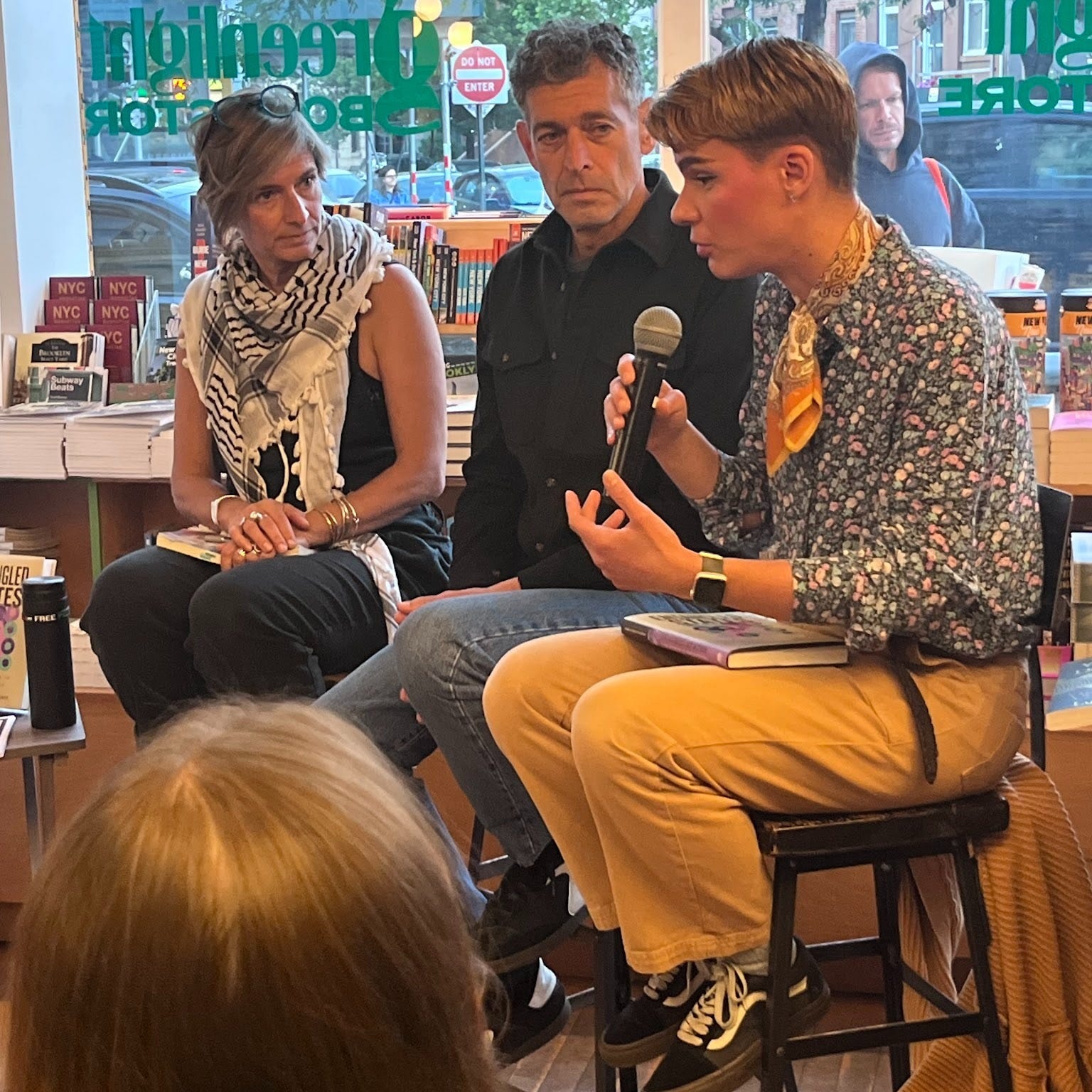
asserts Badkhen. In June, we spoke on a panel together and she mentioned having at times been resistant to the idea that the purpose of writing is to provide hope. As the youngest writer on the panel, and one without any formal training, I took this in as a piece of data rather than something I ought to opine on. But in the months that my own book, Entangled States, has been in the world, I have repeatedly been surprised by how many readers absorbed it as something adjacent to a self-help story, even if so generously peppered with rigorous quantum physics.
So, one one hand, the violence of the statistics and archives. On the other, hope and empowerment. Language can cajole different worlds into existence, if you only realize that you’re wielding a force.
Accordingly, the parts of To See Beyond that are most hopeful are those where Badkhen considers the possibility of the written word.
“To remain in awe, to linger, to reject “the kind of provincialism that vitiates the imagination,” to reflect the world back at itself at unexpected angles, and to invite us, the audience, to ponder and question while reminding us that we are not alone, that someone is as perplexed and bereft and amazed as we are: That is, I think, the obligation of a writer on our overwhelmingly volatile planet,”
reads one hopeful prescription.
Among all the poor faith headlines about how reading is over, how no-one cares about books anymore, maybe doesn’t even have capacity to understand writing anymore, I still found this encouraging. The writer must be careful to not only question and reflect the world at one level, but maybe their power lies exactly in this, in pointing towards what stitches all the levels together.
The unification of laws of physics is a difficult problem. In fact, mathematical work on how to stitch together laws that govern the behavior of fluids and that range from microscopic to macroscopic was just this past week awarded the Fields medal, mathematics’ most prestigious award. How can a writer do such stitching then?
Badkhen grapples with this as much as she grapples with that problem of feeling love but observing hate, which baffles me as well. But just by writing it down on the page, by putting them side-by-side, some process gets its start, some attempt to think of reality as richer than it might seem. “Maybe the writer’s role is to remind us that we live in many kinds of love and are always inadequate to the grief and suffering of the world, and to invite an introspection,” Badkehn hopes. Clearly, it worked on me.
A while back a feature commission briefly plunged me down a deep rabbit hole of what exactly emergence is. There are physicalists and reductionists who will tell you that a whole is just a sum of its parts, a collective in the same way that I have described a phonon or any other quasiparticle. In this view, what matters most is what is at the bottom, that’s where all the determinative power lies, that’s where the truths are. Emergentists, on the other hand, believe that a sum is bigger than its parts, that there is a level of reality that cannot be explained by simply enumerating them and their interactions.
There can also be a mutalist view here, one where the emergent structure constrains the parts that it emerged from and those parts shape the structure itself. One example is a cell that is defined by its membrane, but composed of atoms, none of which have membranes themselves, but can form one through physical interactions. Importantly, a mutualist would say, the atoms don’t participate in membrane-producing processes unless the conditions are exactly right – they’re parts influenced by the emerging whole.
The more I read about these three views, the more indecisive I got. Why couldn’t you trace everything down the bottom of some ladder of realness? And how could science not have answered this question yet? One philosopher admitted to me that part of the problem lies in scientists and philosophers not talking to each other enough.
They all do ontology, or catalogue stuff that really exists, and metaphysics, he told me, but some researchers like physicists never acknowledge that they do and some philosophers never talk to physicists at all. The whole thing was sort of ironic, a problem of what emergence really is emerging from putting a bunch of smart people together to form academia. But it also alerted me to the urgency of self-reflection, humility and incessant questioning. Even among the brightest minds rushing to find the biggest truth, the quest can fail when they don’t have enough of these things.
This realization seemed too trite to write about. Of course we always ought to be asking more questions, isn’t that just that worn out line from Socrates? Reading To See Beyond dissuaded me of this. Sometimes posing a question is the most responsible use of language and an obligation to the truth becomes an obligation to simply never stop asking it.
Whatever it is that makes the world so baffling and terrifying, a sum of parts gone wrong or something magical that transcends that sum, may render us unable to hypothesise at times. We can be too struck by grief to be able to speculate, the pain can get too personal for any problem to ever seem truly abstract. But introspection, self-reflection, a sense of inquiry, a sense of naming the thing that feels like it’s pulling us apart like tectonic plates bursting the Earth’s geological seams, that remains an option. What do we owe each other and this depraved world? At a minimum, to keep asking questions.
***
In the last chapter of To See Beyond, Badkhen writes about “breaking bread in extremis.” She means that in the sense of sharing meals in areas struck by war, but in the margins of my copy I immediately scribbled “isn’t that what’s coming for all of us?” Ecological disaster is already here, my eyes still sting a little from wildfire smoke that made air in New York unsafe to breathe recently.
At some point I started keeping a list of press releases about climate change and food. It features headlines such as “Climate change cuts milk production, even when farmers cool their cows,” and “Cold bacteria help fix the smoky taste of wildfire-tainted wine?” and “Climate intervention may not be enough to save coffee, chocolate and wine, new study finds.” Regardless of whether I ever had any real ambition to write about the future of food, this list now increasingly reads as a catalogue of what the near-term will taste like, an archive just waiting to be fulfilled. Our palates are not ready for the taste of that bread, and our hearts might not be either.
Yet, that difficult issue of scales presents itself here as well. Beyond the bread, if you squint, what you see is a moment of sharing and a moment of care. Maybe the bread is terrible but we are together, trying to nourish each other. Badkhen writes about breaking bread for similar reasons that she writes about visiting holy sites.
“I may never trust myself to understand what God feels like, but I have always known what sacred feels like, the tremor of it. Holding someone’s trust can feel this way, and also bestowing it; the holy of falling in love,”
she notes. And then, a few pages later: “Love is a kind of imagination.”
Maybe love is the thing that can transcend all scales, much like a divine ought to. Maybe it’s the ultimate thing we ought to be conspiring to make grand, grander than each of us alone. Many of us are already lucky to know that it can permeate even the smallest instances and interaction. This too is trite, but with the whole future on the line it’s hard to care about being cool or detached. There is no virtue in being uncaring in the face of a disaster. Badkhen seems to care ferociously regardless of all that she has seen. To See Beyond makes it clear that this is not easy, it also illustrates moments of reciprocal care with touching beauty. “She has friends everywhere,” I wrote in the margins, a scratch of jealousy making my throat constrict.
Miraculously, a bit of quantum physics shows up in Badkhen’s book – a nod to the inextricable link of quantum entanglement as “the latest way of retelling our connectedness.” I’ve spent year thinking about this too, about theories such as relational quantum mechanics or the Bohmian interpretation of quantum theory which posit that nothing is real other than our relations to each other and that everything everywhere is connected, respectively. Now, I’ve heard that philosopher loud and clear, I don’t want to be doing ontology haphazardly. But it’s an emotional conspiracy of sorts that two different writers spontaneously align on the same metaphor. Underneath it, we may have been asking the same question, formulating the same hypothesis. This too is a connection that feels hopeful.
Often, I wonder whether my training as a scientist actually prepared me to understand my world when it is in turmoil. Can the scientific method and traditional problem solving really do that much for me here? For moments when it all starts to fail, I am assembling new steps: leaving no level of reality unturned, asking questions even when they don’t have answers, looking inward as often as it is bearable, and, when reaching outward is possible, offering nothing short of love and devotion. I know you’ll see me exercise them on the page.
Thank you for being here,
Karmela