
Irresistible Force
On cooking fraught recipes while depressed
Thanks for reading my newsletter! All opinions expressed here are strictly my own. Find me on TikTok, Instagram and Bluesky. Ultracold publishes every Monday and my debut book Entangled States: A Life According to Quantum Physics is now available everywhere books are sold.
IRRESISTIBLE FORCE
A craving can change everything.
Midway through May, firmly positioned at the intersection of a months-long depressive episode and maddening anxiety about the publication of my first book1, I had a Saturday to myself, with no particularly strenuous to-do list. I had to walk to the nearby neighborhood community space to pick up our farmshare and the rest was up to me. I could spend the day in bed if I wanted to, feeling blank, like I might disintegrate into nothingness. Or I could refresh my email a ton, conduct embarrassing Google searches and fall down envious social media rabbit holes. To keep either tendency at bay, I filled up my schedule with a trip to the grocery store, a run and a workout, and an intention to finish the two books that I was in the middle of reading. Routines have always kept me if not at my best then at least well enough to get by, and not getting by didn’t feel like an option.
The farmshare was especially generous this week so I was pleased to be carrying home ramps, rhubarb, maitake mushrooms and a big bundle of chard, its thick leaves lush in their dark green. The sun was bright and only getting brighter. When I started sweating I worried that the vegetables might too. At the grocery store, picking up staples like lemons, tofu, apples and beans, I eventually meandered into the canned goods aisle. Faced with rows of oversaturated images of tomatoes, beans and peas, my purpose for being in this Met Fresh supermarket suddenly became crystal clear. Into my plastic red basket went a can of fire roasted diced tomatoes, red kidney beans, coconut milk, and, after hurrying to the next aisle over, a jar of peanut butter, the kind whose only ingredients are peanuts and salt. With all of this and the chard I would make a peanut stew, something that I was now craving in that singular way where the craving itself already has an edge of deliciousness.
Because I don’t live in a movie, I didn’t drop everything to make the stew once I got home. I washed and put away all the vegetables, placed the cans and jars in their designated place in the kitchen cabinet, and made myself a quick and lazy sandwich for lunch. I finished one book and took notes on it, then went for a run. The day was moving along in recognizable beats, a rhythm I could mirror by letting my feet take me down the street, up a hill by the cemetery, and ultimately to a park. Glimmering with salt and heat, I passed teenagers huddled around their phones, cast short gazes at every early summer picnic and made anxious eye contact with several small dogs out on a walk. Somewhere in my chest, my heart was beating and pumping blood to keep me going, but I wasn’t feeling for any sensation deeper than a gauzy sense of being in constant, unstoppable motion.
The question of why objects move and what makes their motion change is one of the oldest and most foundational in physics. Understanding motion was an early triumph of the kind of mathematical, rationalist physics that was ushered in the 17th century by Isaac Newton and his compatriots, “the blueprint for what the new age of science could achieve.” When Newton’s famous three laws were first taught to me in the seventh grade, I misunderstood them to be about forces, but really they are about why objects move, and their predictive power concerns the same. Newton correctly argued that an object in a state of moving with a constant speed or a state of rest will not change that state unless a force is applied to it. In other words, objects have inertia, and you have to fight that inertia to make them do something other than what they are doing already. Once in a state of constant motion, however, no more force is necessary – a perfect ball rolling down a perfectly frictionless floor at a constant speed would maintain that speed forever without having to be touched.
Newton wasn’t the first person to consider this question. In the ancient times, for example, Greek philosopher Aristotle theorised that all motion was divided into “natural” and “violent.” The former was motivated by the four elements aligning themselves according to some primal sense of balance, while the latter required a constant external force. In Aristotle’s view, for instance, a rock falls to the ground when dropped because it is made of earth and wants to be near more earth; this is its natural motion.
Both of Aristotle’s ideas about motion turned out to be incorrect. A rock falls to the ground because of the force of gravity, which is external to the rock. Because a force is acting on it, the rock actually falls with increasing speed until another external force, air resistance, gets involved. At the same time, any object that is experiencing a force at all times will accelerate and accelerate and accelerate some more, unable to move steadily until the force is taken away.
Contemporary with Aristotle, in what is now China, Mozi of the Zhou kingdom was writing about similar ideas. In the Mo Ching, a philosophical text written by Mozi and his followers, explanations of how the world works range from ethics to physics, including writings on motion. Here, cessation of motion or stopping is attributed to an opposing force. To a modern reader, this again points to the idea of inertia, or resistance to changing motion, whether it be accelerating or stopping.
As a person rather than just a moving object, inertia is something that I fear the most. I fear becoming stuck in an unchanging state, a stagnant state, or a state where my barreling towards some sort of badness just keeps on forever. Accordingly, my experience of depression has often been one of either lacking or searching for that external force that can bring about some sort of change. Something that would make me stop when my fear of not being good enough steadily leads toward working so much that I burn out. Something that would stir me out of relationships or routines that are stagnant, where what is happening is not enrichment or growth or even comfort. Something to, ultimately, get me out of bed even when everything about the world feels featureless and blank, from images of genocide broadcast on my phone 24/7 to the American government trying to legislate people like me out of existence.
While being depressed has, for me, meant being sad or feeling down, the feeling that is underneath the sadness and makes the condition unbearable has often been an inability to imagine change. When I am at my worst, I try to look towards the future and only find something rote and constricted there, if my mind manages to extend ahead at all. This is not to say that all change is good or that I don’t desire stability, nor do I wish to glorify the late capitalist need for constant, overconsuming, toxic growth. But it is still true that my darkest moments have historically been built on a foundation made from fear of an unbeatable stuckness, of not reaching or becoming something different regardless of how much I try. In the most nightmarish scenario, the external force never materializes.
So, I am always trying to be my own external force, my own instigator of change. My routines provide comfort, but they cannot be so rigid as to become inert. My runs feel good in their steadiness, but I am at my best when I feel like I am gaining speed, when my body is not just on autopilot but consciously exercising more and more of its strength. But there is also a catch-22 at play here. You need to overcome feeling down to become your own external force the whole point of which is to overcome feeling down.
Sometimes I think about how Hugh Everett, one of the most prominent advocates of the idea that quantum mechanics implies that we live in a multiverse, wrote to Albert Einstein as a boy, asking what would happen if an irresistible force were applied to an immovable object.2 Already an incredibly successful physicist, Einstein wrote back that neither an irresistible force nor an immovable object exist. I think he may have overlooked the emotional inertia of a bad depressive episode, which sometimes feels like the most immovable thing in the cosmos. How could you possibly get around that? Answers vary and they can be incredibly personal and idiosyncratic. For me, it’s often been other people, truly external influences that set off small revolutions in my psyche. Sometimes, however, the fix is a lot more mundane, like craving a bowl of stew.

After my run, a solid six miles heavy with the sheer stickiness of summer in a city replete with concrete, as I was rowing, sweeping and pulling dumbbells in my living room, my body felt more real than it had at the beginning of the day. Each muscle contraction and extension felt good in its purpose to help rebuild me, quite literally. I tried to move with intention and control, attuned to my posture instead of just barreling through the motions. At the pit of my stomach, the craving was alive and well, ready to be an agitator and an instigator alike. It intertwined with adrenaline and danced with the endorphins in my bloodstream. I was hungry, yes, but there was also more to it. The specificity of the dish that I wanted to eat stood in stark contrast to the general, all-encompassing sense of anxiety and despair. The dish would be vibrant and textured, nothing featureless or bleak about it at all.
I didn’t grow up eating peanut stew. My first brush with it came shortly after I stopped eating meat while in graduate school but before inundating myself with wellness and health content put me dangerously off of any food that felt too rich. At the time, around 2016, food blogging was just becoming a viable way to make the kind of money that could pay rent. Everyone was painting their own backdrops for food photography and the world of vegan content often flirted with exoticism in a haphazard way, borrowing from whatever culture seemed to lend the often white bloggers an air of novelty and edge. In this corner of the Internet, among lentil-based sauce blasphemously designates as Bolognese and bulleted explainers of different types of matcha, I encountered dozens of recipes titled something like “African peanut stew.” It would take a few years before I learned that no such thing really exists, that what I was recreating in my tiny graduate student kitchen was a conflation of many regional recipes into one amorphous dish that could be sold to readers exactly like me.
In Croatia, where I come from, peanut butter was by itself considered exotic for many of the years that I have spent living in the United States. When I first moved in 2008, I approached it with question marks and suspicion. I learned about PB&Js in college as well as peanut butter cups and combining peanut butter with bananas for a quick snack. During the summer after my freshman year I wanted to make what felt like an American dish of peanut butter and banana muffins for my parents while visiting home and it was a whole odyssey to find a jar in any Croatian supermarket. Several years later, when I read about the stew, the idea of putting it into savory dishes still surprised me.
As a white immigrant from Eastern Europe with my unchecked biases and utter lack of context, I was a perfect mark for all those “African” recipes. But it is also true that they inadvertently expanded my taste and taught me about something new that I could love. In this way food often sits at the intersection of history, power, and pleasure. The peanut stew could be an odd artifact of digital colonialism and it could also hold a special place in my understanding of flavor. It’s really complicated, and it can also be really simple on the tongue.
Combining the acidity from the tomatoes with the fatty nuttiness of the peanuts, all rounded out with creamy coconut milk, soft beans and chewy greens, just tasted so good to me. By cooking it over and over I learned how to make it extra potent with a little tamari and lots of lime zest, and how it could really be pushed to the next level of textural satisfaction if garnished with cilantro and toasted peanuts. I learned how to make this stew give me what I needed when I needed it.
The way I cook has changed a fair amount since graduate school. I meal plan and prep a lot less now and I don’t read food blogs almost at all. Eventually, I started to see their sameness, and their lack of depth and context more than I saw the possibility to expand my palate or learn new techniques. So many recipes now live in a subsection of the Internet that reflects how this current iteration of the market economy made it uninteresting, shallow and often edging on harmful.
Now I also have more than a decade of experience cooking for myself and others so I feel more capable of making dishes more impulsively and more intuitively. A lot of my cooking starts with an audit of the fridge and the pantry but ends in, for the lack of a better word, vibes. When I need guidance on technique or want a deep dive into an ingredient, I reach for a print cookbook first, or seek out a writer whose work feels trustworthy based on past experience and their own ethics. Sometimes I ask myself what either of my nonnas would do with a dish. I try to turn to my lineage and my desires before I turn to the Internet. And for a long time this hadn’t brought me to the peanut stew.
A few months ago, I dear friend did offer me some, inspired by an offering of one of their own dear friends, and though I found it delicious and the daisy chain of friends cooking for friends absolutely endearing, I quickly forgot about it all over again. When it came to me in the grocery store then, not as a vision but a need, it felt like I really ought to not deny it.
Having a craving while in a low place is a reminder that desire is still possible. Acting on that desire becomes as primal, animal, and alive as possible. Appetite as an irresistible force.
Instead of looking for a recipe, I decided to trust my memory and my gut, two things that I have to work extra hard to rely on when my mind slips into that flat, bleak, stagnant state of depression. But now, on this Saturday in my kitchen, cooking just for myself, buzzing from physical activity and a cold shower, I chopped two small onions and sauteed them in a tablespoon of coconut oil like there was absolutely no other thing my hands could ever be doing, It felt good to have a purpose, and one that emerged from some pocket of my body where aliveness lay concentrated and hidden.
I added a few crushed cloves of garlic and waited until I felt my face scrunch with that ‘oh it smells good’ sensation before adding the tomatoes followed by about two tablespoons of dark soy sauce and a generous sprinkle of ground cumin. I stirred it all and let bubble briefly while I drained and rinsed my kidney beans in a colander. I shook a can of coconut milk to make sure it wouldn’t be full of globs once I poured it in. After mixing in the coconut milk, I opened a fresh jar of peanut butter and tipped it above the pot, trusting myself to stop its slow, viscous trickle just at the right time. I stirred, I tasted, I added another spoonful without any judgement for my apparent mismeasurement just moments ago.
The beans went in next. While they simmered I washed and cut the chard, creating a mess of scraggy green ribbons on the cutting board. I added them to the stew, lowered the heat, covered the pot and let it all simmer. Comforted by the barely audible rumble of this simmering, I washed and cooked a cup of long grain rice. The kitchen smelled good, the edges of my mind felt sharp and attentive, and my heart jumped with anticipation.
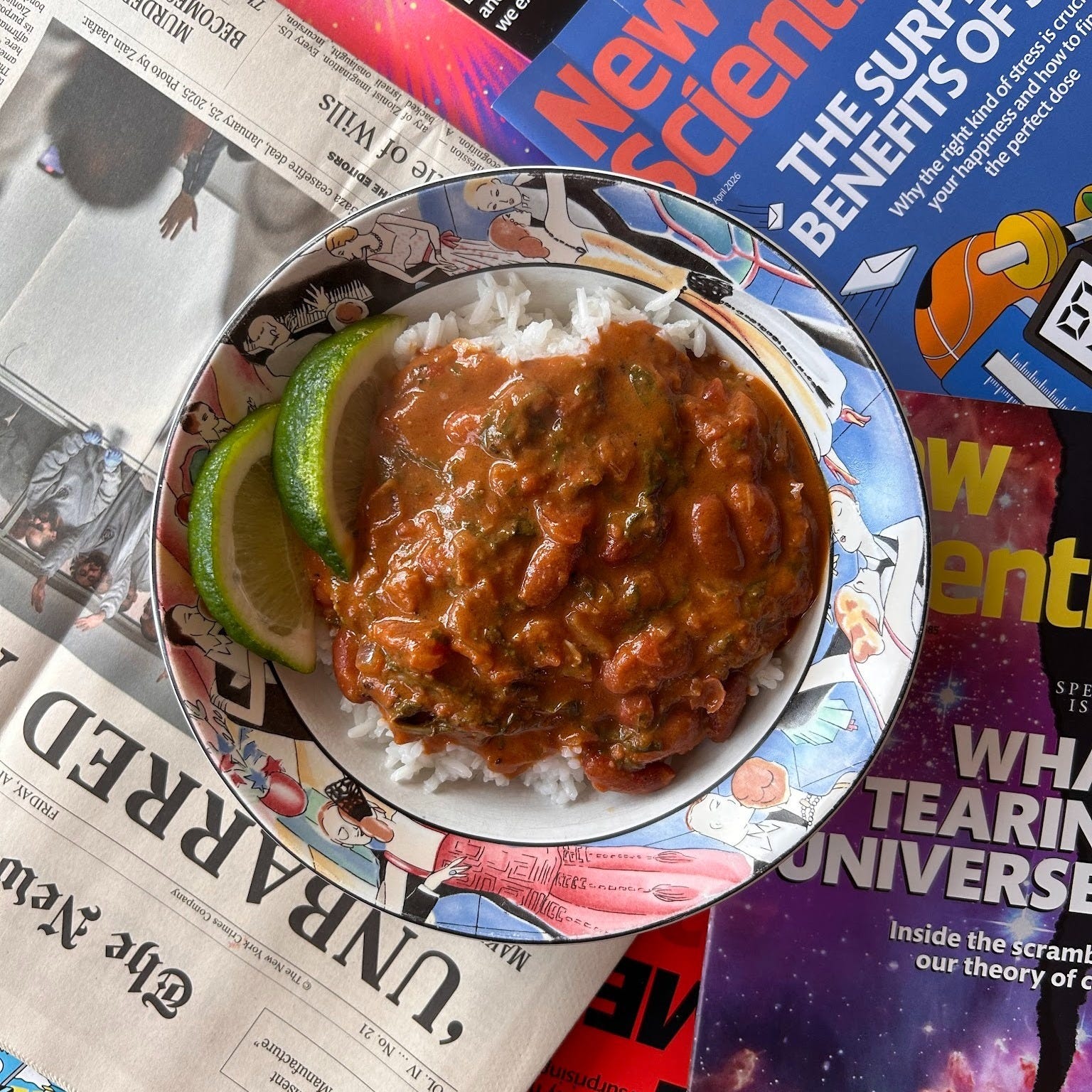
Once the rice was done, after a very long twelve or thirteen minutes, I finished the stew with half a lime worth of zest and juice, more ground cumin, a bit of salt and even less white pepper. When I spooned it over rice in my bowl, it pooled and shimmered in an unassuming and unfussy way characteristic of foods that don’t look like they’re trying too hard but can satiate the kind of hunger that might as well be primordial. Unable to resist a few finishing touches, I squeezed two thin wedges of lime over my bowl and impulsively threw on some dregs from the bottom of a chili crisp jar that lay in the fridge half forgotten. I dug in.
This is why it was worth learning to cook, I thought before even finishing my first bite. This is why having a body is good actually, the second bite filled me with warmth. Maybe it’s good to be alive after all, I admitted to myself as the bowl’s chipped white bottom started to pick through the warmly orange mix of rice and stew. I had seconds before settling into the couch with a big smile on my face, grateful for the craving to had brought me here. Briefly, nothing about me mattered other than that I could desire and that I could fulfill this desire too. I felt big, warm, too satisfied to be any sort of stuck.
As much as I love cooking for others, cooking as a way to make my love tangible and my community physically connected, one of the most basic gifts of knowing how to cook is being able to meet myself where I am. Certainly, cooking is not always joyful. Sometimes it’s rote, it’s tired, it’s a means of staying alive whether that’s pleasurable or not. Cooking means doing labor and it also often means having to eat your imperfections. Maybe this is why take out apps, delivery services that promise access to chefs, and meal plan programs that tout some sort of optimization are so hard to resist for many. These days, I do eat out a lot more than I used to when I lived in a smaller town and on less income; I’m not fully immune to various promises that you can throw your money after. But when I am depressed or when I am anxious or heartbroken or my mind just feels foggy and my soul sticky and inert, what rouses me back to feeling whole is a craving that I can follow into the kitchen and observe energizing my hands and senses.
It is the most basic way in which I can say ‘I see you’ and ‘I’m here for you’ to myself no matter how ugly that self seems, no matter how unmovable in their pain or grief. It’s the most embodied reminder that there is so much more to how I exist than my low moments. Once I satiate one craving, it becomes easier to feel for the edges of the next, to climb the ladder of ascending desires to something that feels limitless and free.
Best,
Karmela
Please consider buying my physics memoir, Entangled States: A Life According to Quantum Physics in your favorite bookstore. Your support would mean a lot!
This question also dates back to antiquity, including Greek myths and Chinese philosophy from the 3rd century before our era
‘But when I am depressed or when I am anxious or heartbroken or my mind just feels foggy and my soul sticky and inert, what rouses me back to feeling whole is a craving that I can follow into the kitchen and observe energizing my hands and senses.’
Same same same!!!
I have started reading your memoir, the first/intro chapter is a banger!
Pretty sure I have a printed out “African peanut stew” recipe in an old binder from around 2014