
Order-Disorder Transition
On eating, order, cleanliness and control
Thanks for reading my newsletter! All opinions expressed here are strictly my own. Find me on X, Instagram and Bluesky. I’d also love it if you shared this letter with a friend.
I wrote this essay after my mom visited me last summer and filed it away for a well-matched pitch call or some burst of energy that would motivate me to send it to some editors. This has proven unsuccessful and my mom is back in town so it felt fitting to finally publish it here.
ORDER-DISORDER TRANSITION*
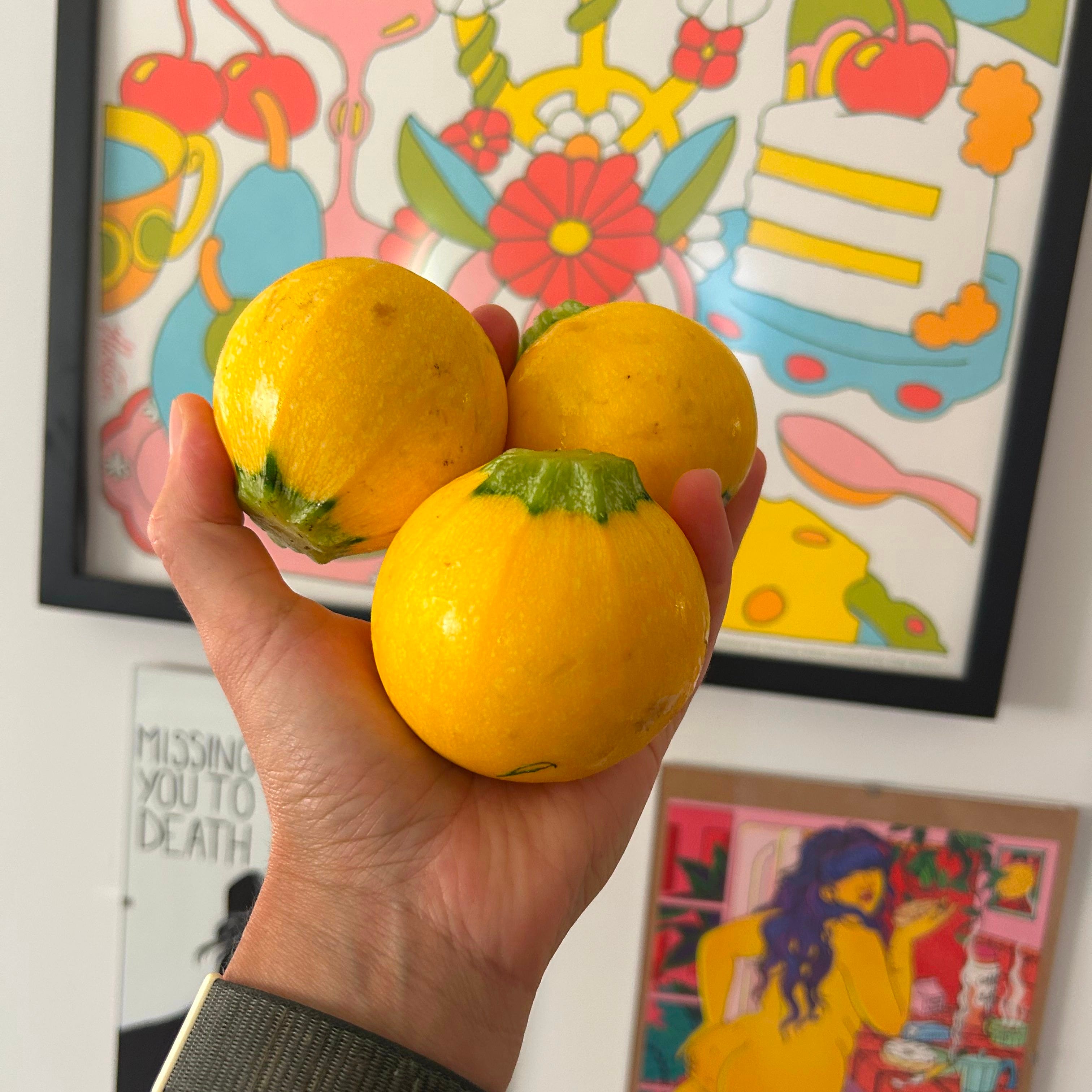
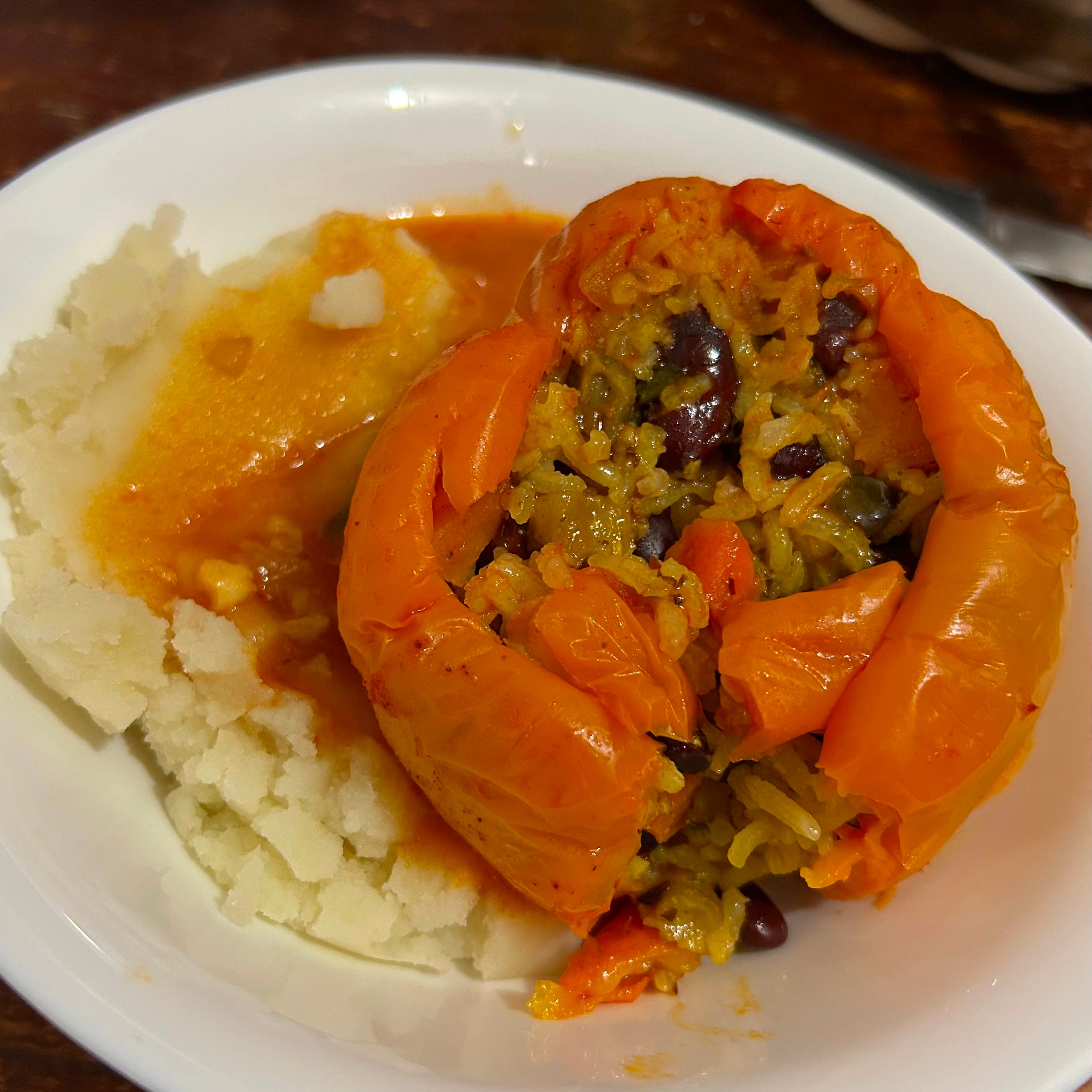
It’s my mom’s birthday and I am giving her grief about squash. Though it is late July, she bought a butternut squash and used it in her stuffed pepper recipe.
“It’s summer squash season,” I tell her.
“The proper thing to eat now is zucchini,” I raise my voice.
“You bought a winter squash,” my heart is pounding.
Then, I taste a stuffed pepper, which is bursting with rice, beans, onions, and the now infamous squash. Instantly, the pepper’s contentious contents calm me down.
A few bites later: “This tastes like my childhood. Even with the squash.”
My mom smiles. She is 58 today, but even the smile lines around her blue eyes, two dots of calm amidst a whirlpool of curly red hair, don’t betray it. She couldn't care less about what anyone says is the “correct” squash - she just wanted this one and buying it made her feel good.
“I’m happy to eat this with you,” she says and nods towards a bowl of mashed potatoes that she prepared as a side.
***
I am no squash expert but I know the difference between a zucchini, a summer squash, a grey squash, a butternut squash, a delicata squash, a carnival squash, an acorn squash, a honeynut squash, a spaghetti squash, a blue hubbard squash, akuri squash, a Northern Georgia candy roaster squash and a kabocha squash. I know which ones are bulbous and which are long. I know which ones are red and which are green or gray. I know which ones have thick skin that you should peel and when to leave the skin on because it will turn soft and a little sweet in the oven. I know which squash is most commonly used for puree and which squash actually makes the best puree. If you needed to discuss the structural integrity of squash for the purposes of braising or steaming, I think I could help you with that too.
I want to tell you that I know these things because I like to know things (I did, after all, spend my whole youth wanting to be a scientist). But I probably have to tell you that I know these things because I also like to categorize and order everything (I did, after all, spend my whole youth training to be a scientist). This is why my mom’s seasonal transgression worried me - by purchasing a winter squash at the peak of summer, she inadvertently mucked up my preferred order of things.
My scientific training is in condensed matter physics, which is a science that deals with fluids and materials, basically anything that you could hold in your hand. So, I have had many conversations with materials scientists about disorder, and, in physics parlance, disorder almost always means dirt.
A disordered solid is one full of atoms that don’t belong, of atomic interlopers that embedded themselves into what would have otherwise been a perfectly neat and clean structure. Sometimes, disorder also means that a solid’s atoms are slightly out of place, endowing its structure with awkward gaps. In either case, disorder either traps or destroys.
Suppose you’re an electron trying to move through some solid, such as a piece of wire. Maybe you just want to join your other electron friends and form a river that we call electricity. Maybe you and your electron friends want to do something unusual, join forces and surprise physicists that study you, maybe by doing something quantum. If the material is disordered, if it is full of junk, all your plans will be squashed.
You may get stuck between two pieces of dirt or within some imperfect gap, and your friends might not respond to your bid for collaboration because of all the disorder between you. Nothing good happens within a junked up, disordered material. Or at least that’s what I thought I learned in my physics classes.
Some condensed matter physicists become experts at making materials, at growing them as if they were decorative gourds at the pumpkin patch. A lot of their work comes down to keeping those materials free of disorder, to making samples that their colleagues then call “clean” with awe.
***
Butternut squash is not common in Croatia where I grew up so I only learned about it when I started reading food blogs in college. I read about butternut squash soup and learned that you can cut the gourd into cubes, roast them, then throw them in a kale salad. In graduate school, after I stopped eating meat, I made both of these dishes repeatedly. From the Internet, I learned to call them cozy and comforting and, sometimes, to also call them “clean.”
I was pursuing a PhD which, for me, meant living alone in a small town in the Midwest, both teaching and taking classes, and working on several research projects, all at once. The amount of work that was constantly piled on my plate was often overwhelming. And there was really no fixed end in sight, just a vague promise that I would graduate once more senior scientists deemed that I was sufficiently mature and my work sufficiently impactful. To combat the uncertainty and dread of it all, I craved control - and I craved order. Becoming a “clean eater” seemed like it could give me both.
Each Sunday, I would write a neatly ordered list of dishes, spend hours cooking them, then portion everything into uniform, stackable containers. By the end of the day, my fridge had a perfect internal structure, all the building blocks of my diet for the week arranged just right, no awkward gaps and no junk. I measured everything with high precision, and I minimized or eliminated ingredients like sugars and oils that felt like they would junk me up, that stood a chance to dirty the internal structure of me.
The more I did this, and the smaller and cleaner those portions got, the more I felt in control. Colleagues and acquaintances said they respected my resolve and admired my discipline. I was flattered. I was also always turning them down for dinner. How could I eat restaurant food if I couldn’t know every single detail of how the ingredients were corralled into the structure staring back at me from the plate? I was always developing new rules for my diet and the sense of keeping my body orderly by not breaking them was quickly becoming more important than something as stochastic as just hanging out at dinner or at a bar.
Eventually, however, I had to learn a crucial difference between me and those materials samples in physics labs - too much cleanliness and order could be bad for me. I think you know how this part of the story goes: I lose too much weight, I become too weak, I am always cold, I am not menstruating, the anxiety I was keeping at bay by keeping my kitchen in order comes back with reinforcements. Ironically, what is happening to me at this point is called a “disorder.” I keep shrinking and graduate school only gets harder. My self-judgment becomes more demanding too, whether I am judging my academic work or my ability to be healthy and clean.
Around that time, as part of my physics studies, I learned that in some materials the presence of disorder can make electrons behave in a way that betrays a fractal geometry. Fractals are self-similar shapes: if you zoom in on some small part of a fractal you will find the same lines and patterns as if you would if you had zoomed out instead. You can imagine picking a seemingly blank or boring spot in a fractal then magnifying it over and over - the same pattern would come into view at every level of magnification, and you’d be unable to escape it no matter how detailed you got.
This felt like a fitting metaphor. I kept fidgeting with details of my life, taking a more and more granular look at my diet, increasing the precision of my restrictions, and still never reached that place of perfect cleanliness and control that I was craving. I couldn’t win, and I couldn’t break the pattern.
Calling certain foods “clean” implies that others are “dirty” and that people who consume those other foods may be dirty as well. In the context of American capitalism this designation is loaded with racist, classist and colonial baggage. It ignores structural challenges of our food system and it certainly ignores the fact that that system is set up to extract money and value from some people more than others. It also keeps one oblivious of the way in which the notion of “health” has been constructed by insurance companies and the very American drive to make everything feel like a contest in individualism rather than an interconnected existence in a world full of other living beings. Whether a truly healthy person, one who does not need to keep taking of charge of their body to optimize just one more thing, actually exists remains an open question.1
It takes privilege to eat “clean” and you can’t “clean eat” yourself out of poverty or discrimination. I think I always knew this, but as a young queer immigrant, trying to ingratiate myself within the dominant ideology was simply too tempting. The more I learned about politics, the more I understood that I needed to see myself differently, and treat my body differently, but I struggled to actually do so. My politics got more radical, and eventually my plates did also become more full, fatty, sugary and pleasurable, but the lag between the two was not negligible.
***
In graduate school, I would start every weekend by waking up extra early to go to the farmers market before attending the most challenging yoga class offered at the local studio. I enjoyed the market the most in the fall when I could buy locally grown Midwestern sweet corn and try out new types of winter squashes. Once, a farmer sold me a Long Island cheese pumpkin which I still dream about, especially because I have not been able to find another one since. After a few years of letting bloggers convince me that butternut squash is the sexiest of them all, I discovered that I prefer the more starchy kabocha instead. I ate these squash in small servings, measured to teaspoon precision, but their novelty still felt exciting.
Years later, after moving to New York, I will stand in line at a much more posh market and talk my partner’s ear off about my love for kabocha squash. He will watch me inhale big bowls of it cubed, salted and roasted as a snack while we watch TV that evening. “It’s like if a potato and a butternut squash had a baby, but better,” I will try to explain, pointing my fork in his direction. I will do so with a tinge of guilt, an old reflex to think that that much carbs and at such a late hour defies a sense of order that anyone wanting to eat well-balanced and well-timed meals should obey. But I will still do it.
And I will, similarly, get a second helping of my mom’s stuffed peppers, thinking about everything she used to feed me as a child. There were so many junky meals when my parents were both broke and busy: hot dogs with mayonnaise, piles of pasta with cheap grated cheese, dozens of Nutella-filled crepes, eggs fried alongside potatoes in pools of oil. But there were also so many vegetable-forward dinners, real feasts of textures and flavors whenever my grandparents stuffed our bags with their homegrown cabbages, zucchinis, and tomatoes. We had always been a messy family, in large part due to all those structural factors that keep messy broke people from ever “getting their act together”, but around the dining room table we could find it in ourselves to do well, to be well even. I’m sure there were countless instances when my mom bought or cooked something that I would now be tempted to call “wrong,” and yet, for the most part, my memories of eating are almost all synonymous with memories of happiness..
It’s been several years since I gave up my quest for perfectly clean eating, not just because my politics became more radical, but because I got really tired of living in that perfectly ordered yet solitary and anxiety-ridden world. A bizarre bout of a very scary sickness, a global pandemic, confronting my slow simmering gender identity crisis, moving across the country, all of those were also helpful catalysts for making a change that had come to terrify me almost as much as the prospect of being forever hungry, anxious and tired terrified me too. Ultimately, letting go of control, like stuffing greasy roasted peanuts into my mouth directly from the bowl instead of measuring them out one tablespoon at a time first, afforded me spontaneity and pleasure that feel so much better than any praise I received for having been more disciplined. Eating a piece of chocolate after midnight even when I have not hit all the goals on my smartwatch makes my dreams a little sweeter anyway. And I almost never say “no” to dinner plans these days. I’m in a much messier place than I used to be - and I think it’s a good one.
And that whole thing about how much physicists love clean materials? I did eventually become a physicist and I still talk to many of them daily. Just last week, I spoke to someone who specializes in studying defects in solids. They said that some of the richest phenomena actually happen at sites of imperfection. “Oh wow,” I said, as if I had not already felt that.
Best,
Karmela
*In physics, an order-disorder transition happens when a piece of matter transforms in such a way that it loses some of its structure, for instance when an ice cube, which is crystalline so every one of its atoms has a designated place in a neat grid, melts into water which comprises atoms that are positioned much more loosely and closer to randomly.
This is an even more relevant question in the time of MAHA then it was when I wrote this a year ago as one of the core ideas within the movement seems to be that anyone can cure themselves by just doing the right things, for instance drinking (unsafe) raw milk or avoiding certain medications. This is, unambiguously, false and part of a grift that many in the MAHA sphere have built careers on.
You and I have similar mutters and mumbles to our mothers.
Whew, this was beautifully written and as I know you know....EXTREMELY RELATABLE. So potent, thank you for every word.