
Thanks for reading my newsletter! All opinions expressed here are strictly my own. Find me on TikTok, Instagram and Bluesky. Ultracold publishes every Monday and my debut book Entangled States: A Life According to Quantum Physics is now available everywhere books are sold.
This is a monthly edition of Ultracold where I share thoughts on media, food or art that I have consumed recently. Please stay tuned for weekly short essays and the monthly Big Essay feature as well.
MEDIA/DIET (AUGUST 2026)
You can’t choose what turns you on, but desire never has an immaculate conception. Is the thing that gets you off aligned with your politics? With how you want the world to see you? With the voice in your head that scolds you when you don’t do the right thing? As Billy Presley, the reclusive aging actress in Teenage Sex and Death at Camp Miasma, says, in the end it’s all actually about two things: flesh and fluids.
A follow up to Jane Schoenbrun’s critically acclaimed I Saw the TV Glow, this film centers similar themes of where pop culture, specifically film and television, intersect with people’s most intimate selves. In I Saw the TV Glow a teenager, Owen, gets caught up in a TV show that is actually a foray into a different, more authentic life. The television programme is real, Owen is a protagonist, and cramming the whole thing into the confines of the plastic of VHSs is a trick that Owen’s mind plays to keep the terror of trying to be authentic and honest at bay. When given a chance to face this reality and truly become the character from the TV show, the self that’s too scary to look at without filtering it through a screen, Owen ultimately chooses the status quo. Instead of the TV show character, who was special and never gave up the fight, as the protagonist of the movie we are watching, Owen leaves viewers with a moment of profound psychological terror that quickly transitions into an even more horrifying bleak normalcy, the kind where the gears of suburban life just keep on grinding.
I Saw the TV Glow has broadly been read as a story of a trans person who chooses denial of their true personhood over embracing it, and does so to the detriment of their own life, and I certainly felt that watching it. I have tried to imagine a life where I never talk to anyone about my gender, it too felt unbearably suffocating. Teenage Sex and Death at Camp Miasma has a similar questioning quality, it also asks what it takes to be honest and free, but it does so with humor and camp, a lot less angst, and a lot more of the aforementioned fluids.
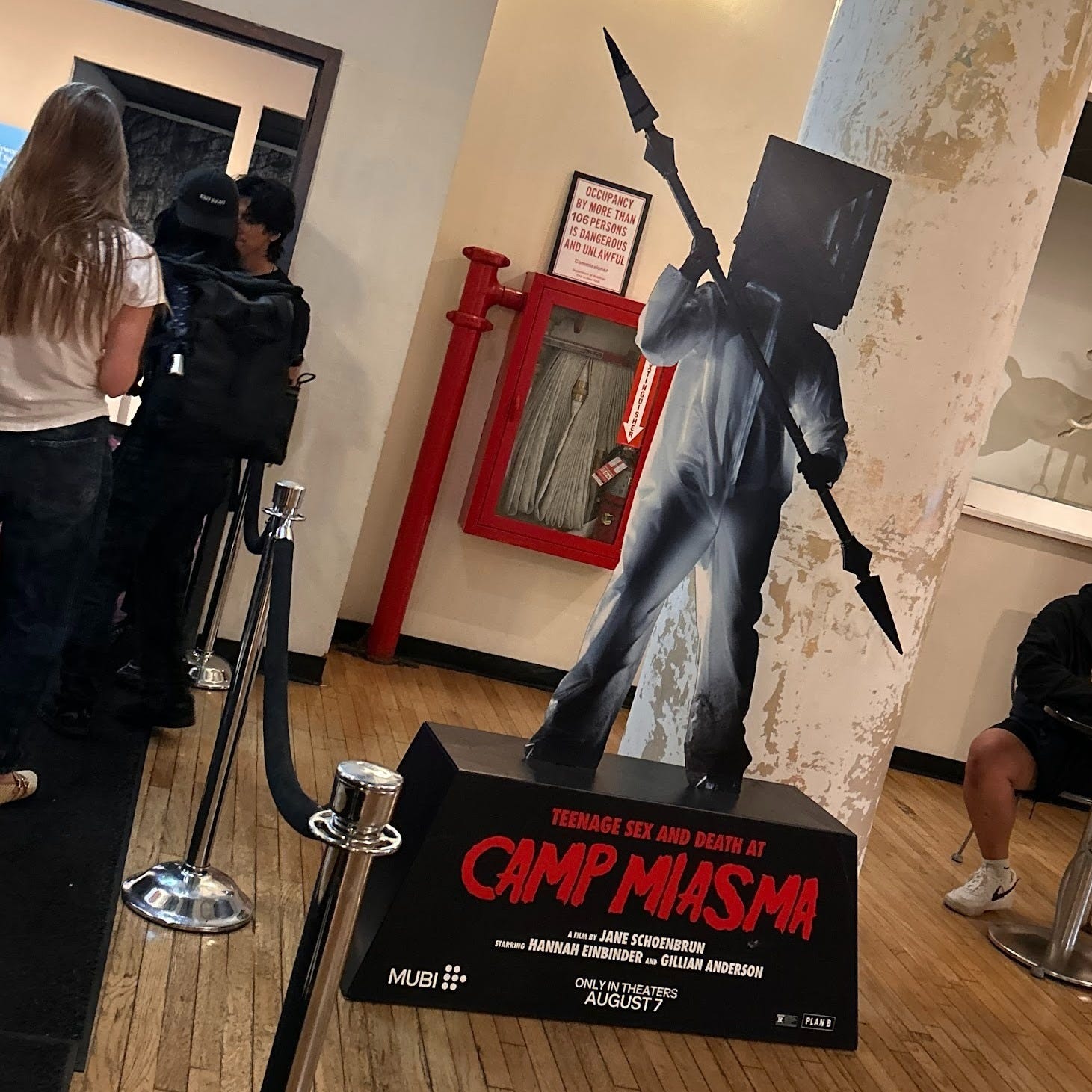
Hannah Einbinder plays Kris, a young filmmaker who has been chosen to revive a “zombie IP” horror film franchise because she is queer and the film, a slasher named Camp Miasma, includes some transphobic elements. Kris is clear-eyed about this and Schoenbrun only really gets to the edge of being overly didactic when Kris starts monologuing about the state of the film industry. Her agent, who would perfectly fit into an SNL skit about playing squash in Bushwick, uses the word ‘woke’ several times, providing some acidic commentary about the politics of movies today. However, it quickly becomes apparent that whatever struggle Kris has with ‘woke’ is not performative nor a matter of trying to look down on someone from an inflated moral high ground. It is, instead, a more internal, and earnest, type of turmoil.
Most of the film is confined to Kris visiting Billy, played magnificently by a Gillian Anderson with a comical southern accent and enrobed in a high femme old Hollywood wardrobe, at her house in the middle of the abandoned camp where the first Camp Miasma movie was filmed. Billy wants to get to know Kris and Kris mostly talks about her work, intellectualizing her queerness and her fascination with horror rather than saying how they feel. When Billy presses, a flustered Kris opens up about not liking, or not understanding sex, even though she is polyamorous and seemingly has a chance to be having lots of it. Einbinder plays this incredibly well, embodying someone who has full understanding of their situation but cannot help themselves anyway. She is, at once, a tender animal brimming with hormones and a disembodied brain in a jar. In one scene, Kris is taking notes on a Camp Miasma sequel and simply writes “DESIRE” in her notebook; she understands that that’s what it’s all about yet she cannot fully feel it. When asked how she likes to be touched in a later scene, when the two attempt to hook up, she delivers stock phrases like “I am in your hands,” and, more comically, “dealer’s choice,” until she breaks down over how she is “bad at sex.”
The two women beginning a sexual relationship is predictable. And, also predictably, things turn out to be not as they seem at Billy’s camp house and slashing and murdering ensues. Schoenbrun has a lot to play with here, from the tropes of the slasher genre to expectations that film and TV ought to become real that I Saw the TV Glow set up for them. Masterfully, they lean in into both without ever losing momentum or diminishing the film’s energy. The notion that horror movies are about sex, whether this is explicit like in the 90s slashers where it’s always horny teens that meet a gruesome fate or not so on the nose, is not new, but Schoenbrun takes that worn out line of analysis and turns it into the dramatic throughline for the movie. Kris can’t get off, Billy is committed to a very literal reading of an orgasm as a little death and, hilariously, this is the name of the Miasma killer too. On paper, all this meta-ness sounds almost obnoxious; in the movie theatre I couldn’t have enough of it.
In I Saw the TV Glow, Owen goes through a surreal moment of bodily harm to take a look inside, into the inner self, but then proceeds to ignore it. The whole film is about that denial, and that’s what makes it devastating. Kris, on the other hand, can verbalize what is inside of her, she has just taught herself to say that it’s all very shameful. Her fantasy is ultimately sort of mundane – she wants to be the victim of a slasher killer, and a slutty one too. It’s so embarrassing and so misogynistic, she tells Billy, worrying out loud about whether watching horror films at a young age corrupted her. In what may be the most bright and affirming moment in the film, Billy counters with “it’s just play,” and her words ring true as Schroenbrun takes the last third of the movie in the familiar direction of on-screen content suddenly becoming real. Teenage Sex and Death at Camp Miasma has a happy ending, and it’s wet and fleshy and full of blood and violence that is at times so over-the-top that it draws out laughter. If Schoenbrun’s previous film was a warning against denying yourself your truth, this film is a celebration of allowing yourself some filthy freedom here and there, it’s a goofy ode to the power of fantasy, especially when that fantasy upsets the cops in our heads and hearts.
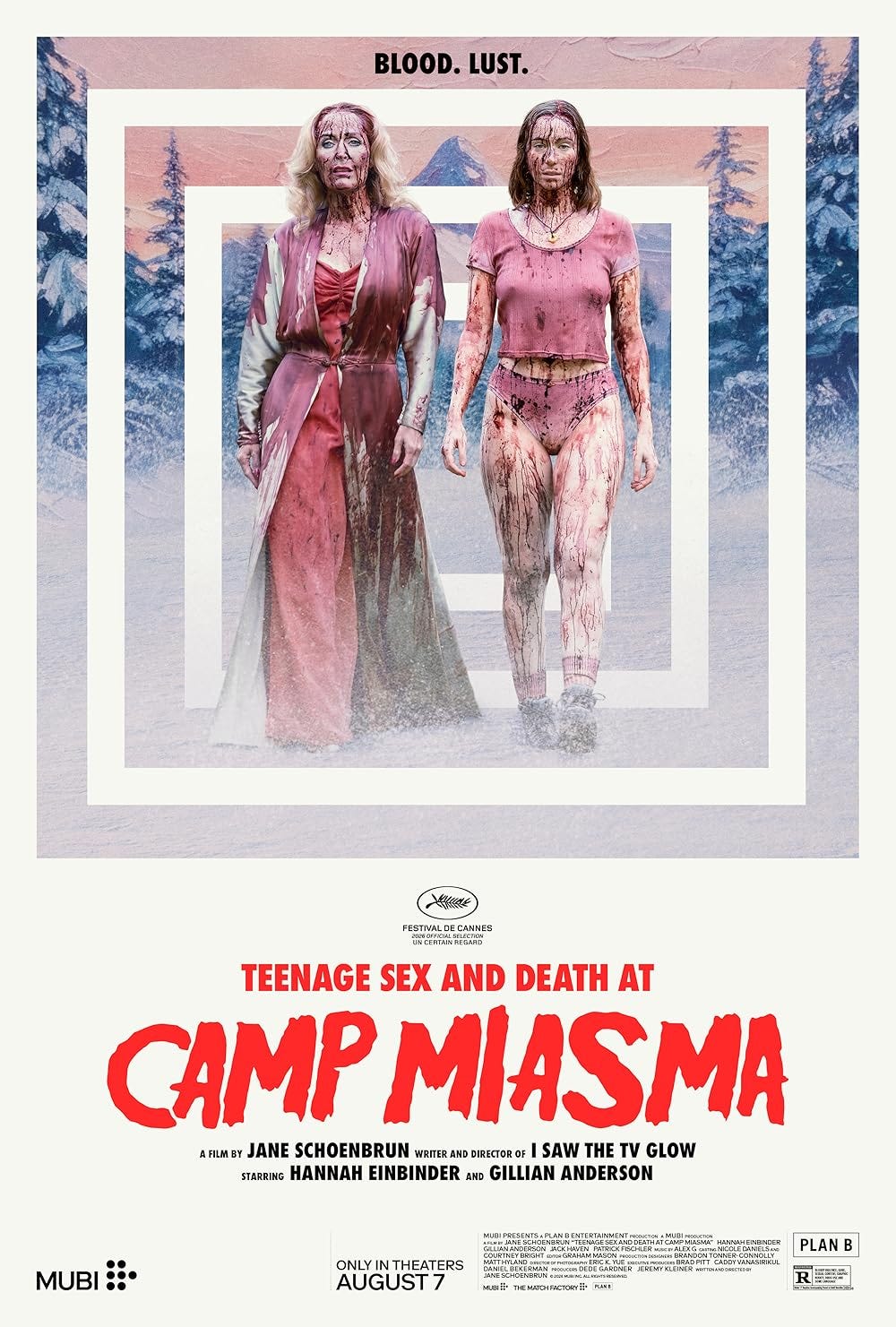
This could have been a scathing take down of the rise of puritanical culture or a tired meditation on ‘woke,’ but watching the film felt like talking to an older friend who really wants you to know that sometimes it’s ok to be a freak. You’re no less of a feminist if you sometimes call your husband ‘daddy,’ or something like that. A little transgression is ok, as a treat, even if the coldly intellectual view of the situation may deem it regressive. I’d lie if I said I wasn’t moved by this, that I didn’t see as much of myself in Kris as I may have in Owen. I certainly grew up at a time when it seemed righteous to look down on characters on TV whose skirts were too short, and it was certainly not very girl-power-like to want to be them. Much like Kris, I have also always been much better at intellectualizing my body and all the things it does and wants, then actually inhabiting it fully. Seeing her release from those internal shame spirals on academic steroids felt cathartic. In the movie theatre, a packed Saturday night screening, I was reminded of how watching Pillion left me feeling that for all its beauty the director and writers were still somewhat icked out by kink, that they were observing it from the outside as a gorgeous curiosity but not anything truly life-giving. Teenage Sex and Death at Camp Miasma is a lot less explicitly kinky but it felt incredibly warm and understanding of what makes desire and sex delicious. It certainly helps that Schoenbrun is an incredibly stylist, a sort of David Lynch with shades of John Waters but also someone who probably consumed a lot of Tumblr, and thay are really funny. Watching their film made me want to be more horny – and more free.
Best,
Karmela