
Media/Diet (December '25)
Fleshwork by Pupil Slicer + Russian cabbage pie
Thanks for reading my newsletter! All opinions expressed here are strictly my own. Find me on TikTok, Instagram and Bluesky. Ultracold publishes every Monday and I’d be grateful if you shared it with a friend.
MEDIA/DIET DECEMBER 2025
Thanks for reading my newsletter! This is a monthly edition of Ultracold where I share thoughts on media and food that I have consumed recently. Please stay tuned for weekly short essays and the monthly Big Essay feature as well.
MEDIA
Does metal music really have to be so angry? As a teenager and a twenty-something I would ardently argue that this reading of the genre is deeply misguided. I would call it reductive them produce a whole slew of arguments to the contrary. I would name literary references in various songs, nod to musically complex structures that put metal in lineage with classical music, and cherry pick songs and artists that skewed more heroic, triumphant, futuristic or contemplative than angry. Maybe I’d even bring up that one philosophy book about black metal that I skimmed in college. All of those things were true. It is also true that it was personally important for me to decouple the music that I loved from something as unseemly as rage, to intellectualize it a little and bring it more in line with the person I was trying to construct for myself.
I wanted to be a burgeoning thinker more than an angry kid so the answer to questions about the emotionality and expressiveness of metal was really a statement about me. I liked its most screechy, grating and dissonant varieties but I could justify this seemingly unseemly affinity. A few weeks ago when the mathy, groovy riffs and frantic blast beats of Pupil Slicer’s Fleshwork firmly lodged themselves into my brain, I had to revisit the issue. After all, the band’s tagline is “trans inclusive radical hatred.”

Reading reviews of Fleshwork also brought me back to a younger yearning to be seen as sophisticated or erudite, especially online. This is because the fairly eclectic smattering of songs on this record seems to bring out bloggers and critics’ worst tendencies with naming genres instead of describing the music. “Gleaming take on mall-ready metalcore,” reads one review, “prog-mathcore,” names another before checking off black metal, post-rock and new wave in the next paragraph and then nugaze in the one after. A third review invokes “tidal swells of black metal and grindcore, while another one notes “a haze of grindcore, savage industrial elements, all mixed in a blackgaze grinder.”
A decade ago I may have cared about the difference between nugaze and blackgaze or mathcore and prog-rock, but reading the words now mostly reminds me of how much easier it is to work on your verbiage than confront why a record filled with discordant sounds and no shortage of anger and despair resonates emotionally. I can’t speak for other writers, but for me it has always been easier to split hairs over genre labels than admit that I wanted to immerse myself in music that mirrors some of my worst moods. When Martyn Coppack at Echoes And Dust called Fleshwork a “bleeding scab of a record,” that hit closer to home than any other qualification.
Pupil Slicer is a trio from London, fronted by Kate Davies, who also writes the band’s lyrics. In interviews, they are frank about what drives both their song-making and lyricism. “These tracks explore both my own experiences as a non-binary autistic person, as well as the more generalized treatment of many kinds of minorities as a whole,” they told Metalsucks. “Fleshwork concerns itself, in unblinking fashion, with human cruelty. Within that, it studies the ways oppressive structures, from capitalism to government bodies, dehumanise people,” writes Emma Wilkes in Kerrang, with Davies noting that one of the songs is inspired by their “helping a friend to appeal against the Department of Work & Pensions’ decision to cut their benefits, after incorrectly deeming them fit to work.”
In an interview with Femmusic they echo the sentiment: “Fleshwork was actually the easiest and smoothest process we’ve had writing and recording an album so far but I would say the biggest challenge has just been surviving in general given the current political landscape.” So, Fleshwork is not just an angry record, it’s a record angry about the details of our time, and how they become material reality for specific people. This is, in some sense, the most potent kind of songwriting, grounded in something particular enough to be unambiguously real yet universal enough to grab you even if you don’t know the details. I put on Fleshwork because it seemed to intersect with genres that I like, and it worked for me purely as a piece of music. Then I dug into its backstory and realised that it also spoke to me in a similar way that fast, crashing, violent and dark records resonated with me as an awkward and depressed teenager. The anger, and the anguish, were, in both cases, very much timely.
Fleshwork opens with an avalanche of noise in Heather, which is broken up by a motif that both reminded me of video games and of learning what numetal and mall goths were when I first moved to the United States in 2008. Some of that culture clash I had experienced at 16 is encoded into this album in a way that is more nostalgic than cringey. I had come from a scene where all metalheads had to be fluent in Deep Purple and Black Sabbath to be taken seriously, but my American peers seemed to be less encumbered with that sort of history and more susceptible to angst transmuted into sound. Fleshwork has both going for it. Its references are clear but it is nowhere near being a paint-by-numbers imitation. In it, I heard echoes of Converge, Meshuggah, Gojira, a touch of Godflesh and lots of Dillinger Escape Plan.These are not bands that I necessarily grew up with, but they were still making notable records when I outgrew the idols that I inhered from my father and his allegiance to the new wave of British heavy metal. In this way, Pupil Slicer have made a record that feels contemporary in its lineage.
The whole first half of Fleshwork is really just packed with sound, a sort of aural horror vacui, not a moment left safe from a riff, a screech, a growl. Most songs on the record clocking in at about 3 minutes, but still manage to carry small narrative arcs in the record’s overall attempt to braid together everything that a person may find upsetting right now, from ecological destruction to the greed of the one per cent. The second half of the record kicks of with the Deafheaven-esque Nomad, which culminates in a bit of vulnerable clean singing which feels both raw and beautiful. It is the sort of song that proves that extreme genres can make the pit of your stomach rumble without necessarily feeling fully alienating. Songs that follow are a little longer and pack a bit more heaviness without losing the intricacy of their rhythms, a perplexing weight on your chest rather than a punch in the gut.
Fleshwork starts on a note that feels like a flirtation with metal that can be pegged to an era roughly fifteen years ago, but by its end it warps the sense of time enough to feel crushingly timeless. The band have been explicit about this not being a conceptual record, but there is certainly some worldbuilding happening here, and it is easily immersive. The closing track, Cenote, is a galloping seven minute tour across the world Pupil Slicer have built, and it layers Davies clean and growled singing on top of melodies that would feel wistful where they not undergirded by anxiety-inducing drumming. The album ends with “Time tells lies\ The earth is blind\ The moss covers where we lay,” which is an unexpectedly peaceful offering; a return to nature and its magnanimity even after all the human badness that Fleshwork have just enumerated. Death and black metal bands have always been interested in natural forces as the most absolute and terrifying, and Pupil Slicer use the trope skillfully here.
The relentlessness of time and the natural world’s ability to eventually turn us all into dirt underneath the moss again made me return to the question of anger, and not just the rational, useful kind. Certainly, there is immense value in anger when it is felt and voiced by the marginalized and the subjugated. Part of the struggle for freedom and authenticity is to recognize the confines of respectability and the constraints of always trying to be a rational and agreeable subject. Being angry often means grappling with the futility of believing that you will be granted your humanity if you just ask for it eloquently enough. History strongly suggests that this alone tends to be a losing strategy, that all those sayings about master’s tools in the master’s house do hold truths. So, anger can be a sign of an awakening, an impetus to find our own way, a beginning of a much needed rebellion. When it doesn’t turn into bitterness over time, this kind of anger is powerful, and it can also just feel good.
But what about hatred, anguish, and the kind of rage that stems from pain, or something more desperate, instead of righteousness? This is the sort of darkness that is sometimes hurled at more extreme metal genres as an insult, and one that many bands have embraced as another flavor of rebellion. What does it mean to love this kind of art?
The first few times I listened to Fleshwork, I chalked up its appeal to nostalgia for my late teens and early twenties, times when the feeling I’ve since taken to calling depression was more acidic and corrosive and a lot less flat and emptying. Or maybe that is just my warped memory of what it was like to slam doors in my parents’ home or yell at one particularly inconsiderate college boyfriend. The way darkness grabs me now is a lot less loud and a lot less embodied, so my nostalgia for younger years is not just for a time more filled with opportunity to explore and grow, but also for that less muted sense of something livid and roiling within my body, for an undeniable proof that I am very much and fully alive. When Davies growls “Don’t bring me back\ I’ll blossom in time\ Let me rot,” that same tension between possibility and pain as two fundamental properties of life is right there.
The era when I was most visibly anguished and angry was also the era when my identity was most entangled with my music fandom. It was also a time when I was most likely to throw myself in a mosh pit or give myself whiplash at any show that came to my town. In my forthcoming memoir1 I write about how instead of putting my life on a timeline demarcated by months and years, I could arrange it along an axis dotted with favourite records and genres. Big portions of that line would betray an everyday in search of a sort of intensity, both in an emotional way and, when the sound system is loud enough and the crowd sufficiently animated, a physical one. There is a reason why so many fans of music that is loud, aggressive and grating speak of concerts as a religious experience. The sense of something absolute, of something primal, that can be accessed communally, sometimes through not much more than shared anguish and rage, is simply godly in the same way that a flock of birds or a pack of wolves is.
Following my life along the music axis eventually leads out of this era, but leads into one dominated with music for running, lifting, boxing and other things that remind me of the material reality of my body. Even though anger is less familiar to me now, I am still using music to shut off that voice that needs to overintellectualize everything, and that cares too much about being smart. I am still using it to feel something unrestrained within myself, whether it be dark or not. Revisiting a sound like the rageful tapestry of genres interwoven on Fleshwork, which could belong to an earlier time of my life made me realize that I have always pursued music as a reminder that underneath a pretense towards a respectable life or a life of pure intellectualism, I am still also just, deliciously, mundanely, distressingly, an animal.
So, with this record Pupil Slicer offer an inescapably potent mix: millennial nostalgia, righteous and rebellious anger, and a dark intensity that needs to be felt rather than analysed. On early morning subway rides to work it rattled me just right.
DIET
For several years now, a reliable highlight of many of my weekends has been participating in a farmshare run out of a local mutual aid space. I get really excited about a big bag of fresh vegetables pretty much any time of year, but picking it up in the winter is especially exciting because greens really stand out against the cold backdrop of the quickly graying city. Winter shares also present me with exciting cooking challenges because they eventually become a hearty smattering of cabbages, root vegetables, and an occasional winter squash. From November through March or April, my household becomes so incredibly rich in beets, turnips and cabbages that I have to either really become obsessed with one or two recipes that will ensure that I do regularly use them up, or I have to really double down on innovation. The cabbage ‘pie’ that I am sharing below falls into that second category but will almost certainly soon move into the first.
I came across the recipe for this cabbage pie while toying with the idea of using the cabbage leaves themselves as a sort of pie crust for a filling of rice and lentils. I was trying to pin down a recipe for that dish, but got distracted with this one, which originates in Russia and has more in common with American casseroles than American pies. Most recipes include a cake-like batter heavy on sour cream and mayonnaise, which is spread below and on top of cabbage cooked down with onions and, in some iterations, mixed with eggs. Looking at images online I could imagine how tender and rich the crust must be given the acidity and fattiness of sour cream and the eggs emulsified within mayonnaise. I suspect that the right mix of thick, cultured coconut yogurt, vegetable oil and aquafaba could replicate this texture in a vegan recipe, but as my first attempt I settled on a less traditional crust made from yeasted dough, which I am more comfortable working with.
I used this recipe as a reference and, as instructed, doubled the dough so I could roll it out into two shaggy circles2 after it rose. The first circle went into a greased springform pan and I used my hands to push it up the sides of the pan about halfway before adding the filling. When placing the second circle of dough on top I was a little more rough, rolling it a bit too big so I could tuck the edges towards the bottom dough and get some folds at the very top of the pie. I promptly painted on a mixture of coconut milk, olive oil, salt and turmeric for color then sprinkled it all with sesame and nigella seeds, red pepper flakes and one overly heavy handed dusting of paprika.
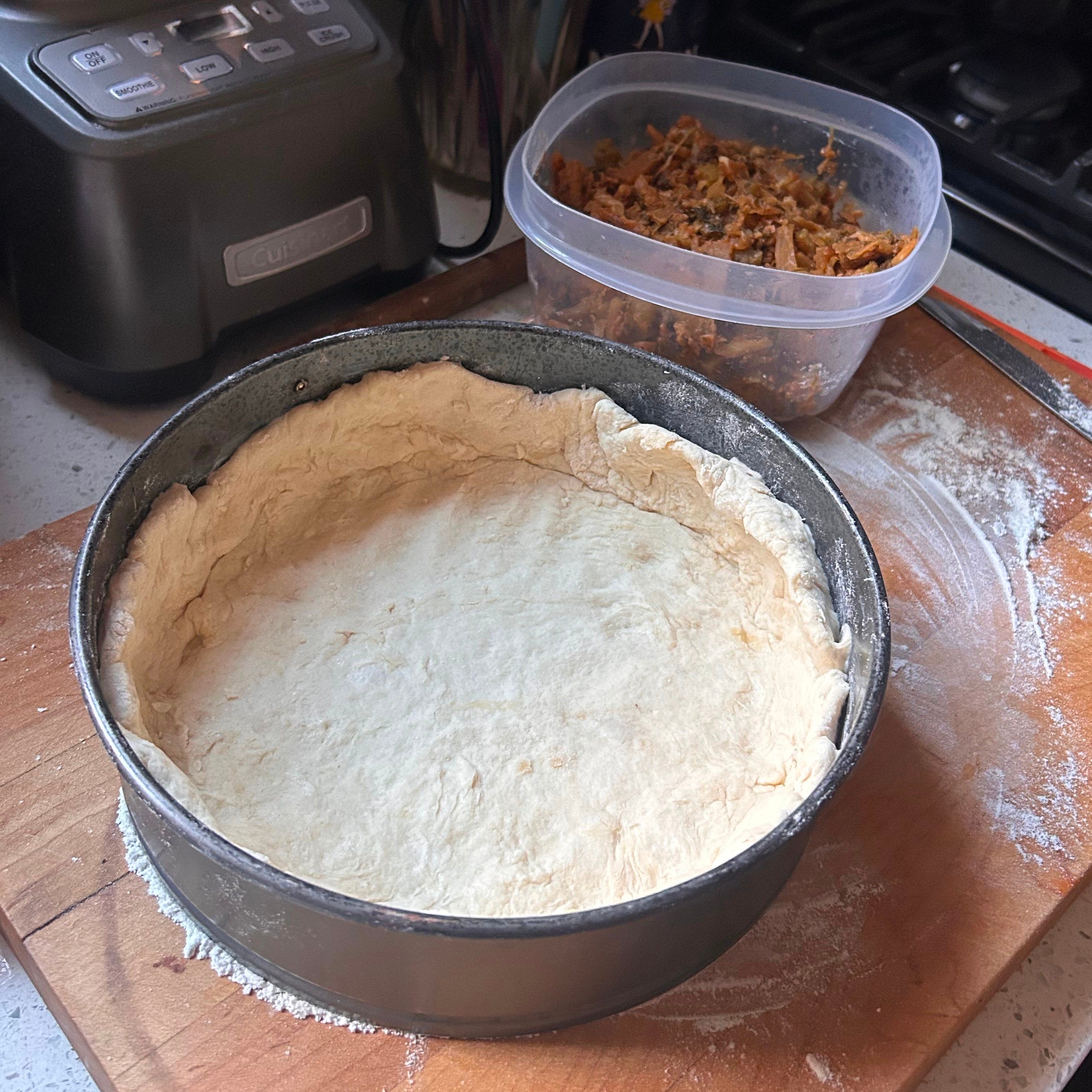

The filling is where I deviated from written recipes the most and stuck to my intuition and the contents of my fridge instead. I sauteed the thinly sliced cabbage with onions, kohlrabi chopped into matchsticks, lots of crushed garlic, and some parsley, seasoning it all with tomato paste and a generous sprinkle of Vegeta. Roughly, I used four cups of cabbage, one cup of onions and kohlrabi each, and four cloves of garlic. Though I measured all quantities and spices by eye ( or maybe with my heart), I tried to be careful about leaving this mixture on low heat for long enough for most moisture to evaporate. Years of making poppy seed and walnut rolls have taught me that the best way to avoid surprise pockets of raw dough is to make sure the filling is not overly wet, and this lesson served me well with this pie too. I baked it for 45 at 350F, peeking into the oven halfway through to add more of the coconut milk wash to the top of the pastry.
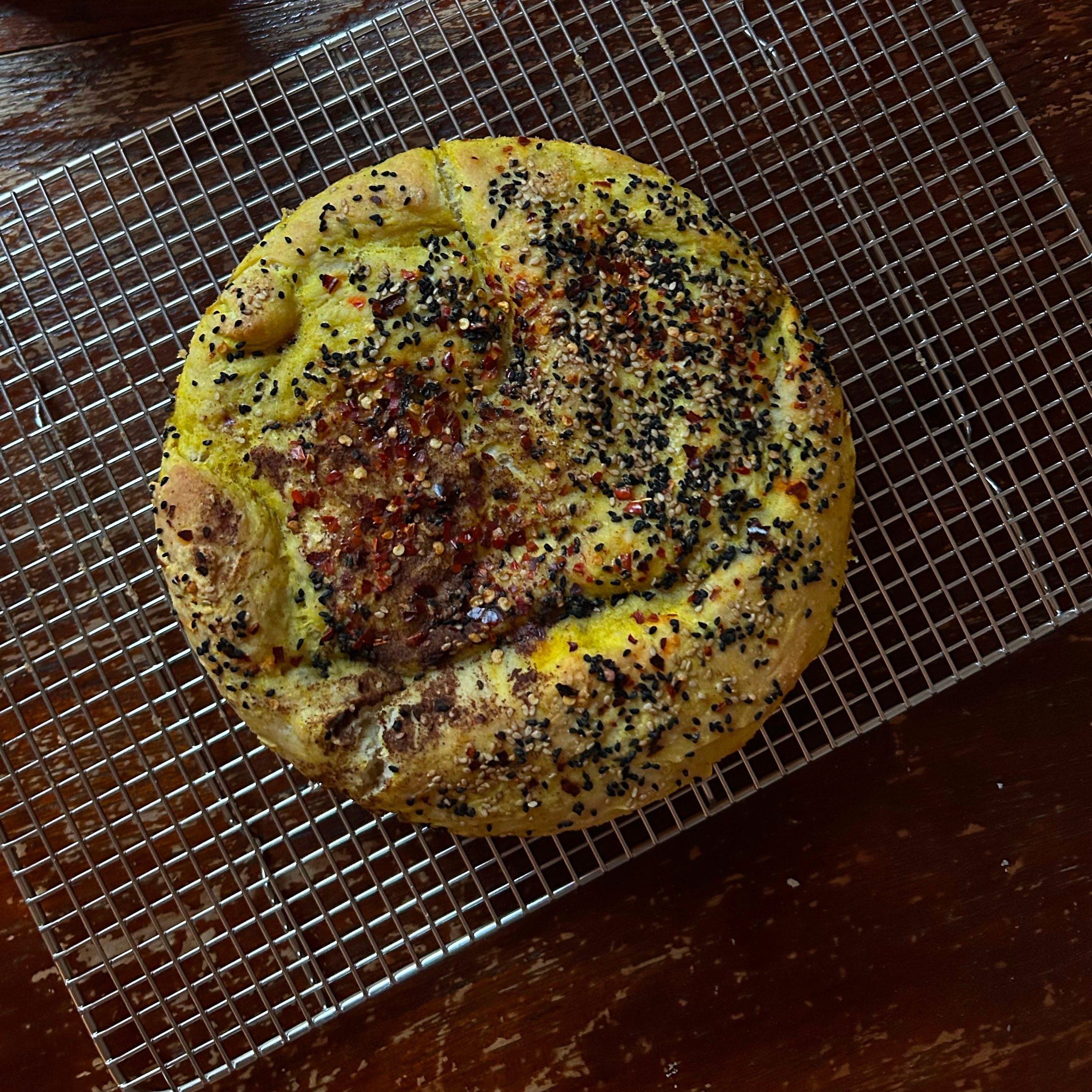
Once the top was golden and springy to touch, I let the pie sit in the pan for about ten minutes then ran a knife around its perimeter, freed it from the pan and let come to a lukewarm temperature on a cooling rack. By the time we ate it, the cabbage pie was soft, fluffy and rewarded you with lots of warm savoriness in its middle. The next day, I was also pretty happy to eat a slice cold.
My overall approach here was pretty unfussy and simple but if I planned a more intricate meal around this pie, I would make a ‘cream’ out of cashews or silken tofu to top it with, and serve it with a salad of marinated white beans and dill, or a bowl of lentil and mushroom soup. And I am already thinking about which seasonal veggies from our farmshare I could add into the next iteration - I am sure there will be no shortage of cabbage in my kitchen all winter long.
Please consider supporting me as a first time author by pre-ordering the book. You can find out how here.
My dough did not get as wet and soft as in the recipe pictures and was much closer to pizza dough than anything else.